TABLE OF CONTENTS

Retail runs on AI now.
87% of retailers have already deployed it in at least one area. It’s projected to be the industry’s top technology for growth in 2025. Soon, AI will be on every shop floor, in every stockroom, and behind every screen.
So far, so unsurprising. As Paul van der Boor, VP of AI at global technology investor Prosus, says “[AI] is having a profound impact on the way we work…The productivity impact is not to be understated.”
That said, he also notes it’s “really hard to keep up” - particularly if you’re a busy retail leader responsible for upskilling and introducing it to your workflows, and those of your team, alongside everything else on your plate.
The risk here is that when AI usage is inconsistent, rushed, or not deployed with a particular outcome in mind, it’s more likely to take up time rather than save it. Conversely, the best results come from AI tools that are carefully introduced to solve a specific problem or clear a specific bottleneck.
In this blog post, we’re going to use an AI in retail case study to show you what this actually looks like in practice. McCoy’s Building Supply, a multi-state US retailer selling lumber, building supplies, and farm and ranch equipment, used AI to transform its internal processes - and in turn, enable its team to be more successful and more efficient. Here’s what’s coming up:
- AI and the frontline today
- The benefits of using AI in retail
- How should AI be used in retail?
- AI in retail case study: McCoy’s Building Supply
- Using AI to transform the L&D content creation process
- Using AI to transform L&D content creation outcomes
By the time you've finished reading, you’ll see how retailers can use AI in a way that’s actionable, scalable, and crucially, going to save time rather than take it away.
Let’s get started.
AI and the frontline today
Currently, about half of frontline leaders in industries like retail report using AI to optimize workflows and improve productivity.
The most common uses of AI in frontline industries include data analysis and insights (25%), and generative AI for text creation, research, and translation (22%).
64% of frontline leaders want to use it more often, and 66% believe it will meaningfully enhance their work. 61% of frontline managers note their companies would be more likely to invest in technology with AI functionality.
So far so good - but there are challenges, too. Frontline leaders may be keen to introduce AI but competing priorities, a lack of time (25%), and minimal formal training and guidance (15%) pose significant barriers to adoption. 22% of frontline leaders use AI informally - that is, taking their own initiative rather than having their actions sanctioned by their employer.
As van der Boor says, “The future is already here, but it’s not evenly distributed”.
Next up, let’s take a look at the impact AI can have on retail businesses specifically.
The benefits of using AI in retail
We’re sure we don’t need to tell you there are almost endless use cases for artificial intelligence in retail industry operations: personalized customer experiences, employee training, inventory management, supply chain optimization, sales forecasting, employee communication…to name just a few.
For leaders responsible for workforce enablement - whether that’s a senior L&D decision-maker shaping strategy, or a training admin juggling content delivery across multiple store locations - AI may seem like a long-awaited answer. Especially when they’re balancing everything from improving frontline performance and reducing turnover to meeting business targets and maintaining customer satisfaction.
How is AI used in retail? A real-world example
Done well, AI can transform business operations - and outcomes. McCoy’s Building Supply used an AI tool to reshape its L&D content creation process.
And the results speak for themselves: a 94% learner satisfaction rate and a 95% training completion rate. This figure is 3x higher than industry benchmarks, and a huge achievement for a business with a workforce distributed across multiple states - proof of how effective AI for retail can be when applied strategically.
But, what does “done well” actually mean - and how did McCoy’s put this into practice?
How should AI be used in retail?
Simply put, there needs to be a strategy behind introducing AI to retail businesses.
A survey from Writer found enterprises without a formal AI strategy report just 37% success in AI adoption, compared to 80% for those with a strategy. And in an industry like retail, where leaders are juggling responsibilities like shift scheduling, compliance, and team engagement, introducing new initiatives with a 37% chance of success isn’t efficient or sustainable.
So, why does strategy make all the difference? Well, generative AI for retail has huge potential, but prompting it effectively can be difficult to get right. The boundaries of what you can prompt are wide open - and depending on how tech-forward you are, or how much time you have to invest into prompt engineering, getting the right answers can be time-consuming. After all, quality of input impacts quality of output with AI.
The thing to do here is to ask yourself this: do I have the time to repeatedly engineer high-quality prompts? Particularly when doing so involves leaving your typical workflows and adding another tool to your tech stack - which can decrease productivity by up to 40%?
If the answer is no, there is another way. Instead of relying on generative AI, you can use AI tools built to unblock specific bottlenecks. The beauty of these tools is you get to enjoy the time-saving and efficiency-generating benefits of AI, without having to pour hours into prompt engineering or head down a rabbit hole caused by inconsistent results.
A recent report from McKinsey has some good insights here, noting that “Retail executives should identify the various domains where a transformation is needed, such as in customer experience, marketing, or store employee productivity, before they identify which…use cases to pursue.” In other words: start with your problem, then move on to the solution.
McCoy’s Building Supply took this approach. Its leaders came to eduMe with a specific bottleneck, deployed a specific tool to use it - and reaped the rewards. Let’s dive in.
AI in retail case study: McCoy’s Building Supply
McCoy’s Building Supply had a problem: its compliance training was delivered in-person, on paper, and as a result couldn’t be tracked or scaled. Training was becoming more and more of a blocker thanks to the business’s ambitious growth plans.
With a workforce of 3,500 located across 3 states, in-person training made it difficult for the company to reach every worker every time. As a result, training took up more time and resources than it should have - and leaders were unable to easily document their efforts and locate their records. This put McCoy’s at a risk of non-compliance.
Jason Trail, Training and Development Manager at McCoy’s Building Supply, explains:
“They were doing it on paper and just sending out a PDF and a sign-off sheet. When it comes to what our legal department needs, trying to get that paper document was a little bit difficult.”
Using AI to transform the L&D content creation process
So, McCoy’s had a clear problem that required a clear solution. This is where eduMe’s AI course creator came into play. The digitization tool uses AI to near-instantly convert PDFs into bitesize digital lessons built specifically for frontline workers.
The key thing to remember here: this AI tech was able to do so without significant time or effort investment from the user. In fact, all the leaders at McCoy’s had to do was drag lesson PDFs into the tool - and let AI pick up the rest.
This had benefits immediately, and later down the line, too. Let’s take a closer look.
Leveraging existing efforts
Repeatedly creating new learning content at scale is a huge undertaking for those responsible for retail worker learning. Every stage of the process - content ideation, creation, editing, and deployment - requires significant time and effort from multiple people. Creating one single lesson could involve a frontline manager, a training creator, an SME and a learning designer, for example. And the more cooks there are in the kitchen, so to speak, the more time and resource-intensive an initiative is.
On the other hand, if a business has a one-person L&D department, the individual will be responsible for creating regular content at scale alongside responsibilities like onboarding, performance support, engaging workers, scheduling teams, and measuring impact. Needless to say, that’s a lot for one person to handle - no matter how proficient they are.
If these efforts go into a training format that is later discarded, they’re wasted. Leaving these lessons to gather dust isn’t an option, which is where an AI course creator - one that doesn’t require prompting from scratch - comes in.
Existing content can be uploaded in PDF format, and will be instantly transformed into engaging digital lessons. The tool has features that automatically identify key information, and then apply best practices to create a lesson that’s learning science-infused and instructional-designer approved, and retains the relevance and personalization of the original content.
Using this tool meant McCoy’s didn’t waste its painstakingly crafted, information-rich, company-branded content - nor did its leaders spend too much time struggling with prompting-from-scratch to build a new, digital version. As Jason put it:
“We like eduMe AI because we can take documents we were using, pop them in there, and generate a course really quickly. We can get a course out quickly to everybody in a matter of minutes versus days or weeks.”
Extract specific information from long-form content
Without AI, creating a specific lesson, even from information you already have to hand, is a significant time investment. We’ve all had to painstakingly trawl through documents for the most relevant parts - and when these documents are hundreds or even thousands in number, that’s a significant task for anyone to go through. Let alone a busy retail leader.
An AI PDF converter can do this task in seconds - meaning users spend 70% less time creating content and still deliver training that’s unique to a business.
Almost instantly, McCoy’s was able to create training across categories - technical training, safety training, sales and customer experience training - like:
- Functional & product knowledge training to ready employees to operate machinery safely and serve customers efficiently - for example, criteria for tire replacement
- Recurring toolbox talks-style safety lessons, dubbed by the organization as “Safety Factors” - for example, how to handle metal products
- Launch of a new customer loyalty scheme, where bite-sized microlearning was leveraged for awareness-building among store associates
Next up - what did these process transformations lead to, outcome-wise?
Using AI to transform the L&D content creation outcomes
A great outcome when using AI in retail looks like:
- The solution is user-appropriate
- The solution is quick, easy, and scalable
EduMe delivered both of these outcomes for McCoy’s - here’s how:
Creating a lesson perfectly set up for the frontline
The results of the eduMe AI course creator go far beyond transforming a PDF into a digital lesson.
These digital lessons are also built just for retail workers - who aren’t tied to a desk or screen. Instead, they might move between a shop floor and a store room multiple times in an hour, or undertake a 12-hour warehouse shift, or be out on the road delivering online orders.
These people might be fitting in training between stocking shelves, managing inventory backlogs, or handling a lunchtime sales rush. They need a way to learn that fits into their busy - and unique - workflows.
The answer is microlearning: the delivery of learning content in bite-sized videos that are easier to consume on the go, and promote knowledge retention too.
The eduMe AI course creator can easily extract information originally intended to be consumed as text (that is, read passively on a page) and transform it into audio-visual lessons, with quizzes and images for memory consolidation and pacing optimized for frontline learners. Using this tool, a training creator with no prior knowledge of learning theory or microlearning would be able to create a lesson following best frontline training practices.
The result? 94% of McCoy’s employees said they preferred the new way of learning - and the business boasts a 95% training completion rate.
Building a personalized content library
Creating learning content for the frontline is time-consuming - and that’s before we even get to personalization. ‘Training that is relevant to me’ is a major desire of the frontline - it positively impacts learning enjoyment, and therefore engagement.
Creating a personalized learning path for each worker may seem like an insurmountable challenge with a workforce in the hundreds or thousands, but it’s possible with AI. In fact, hyperpersonalization is one of the key trends for AI usage in retail in 2025.
When you can create lessons for your retail workforce in seconds, you can quickly scale them to create a content library that workers can move through at their own pace. AI algorithms can also analyze data from previous lessons to create recommendations personal to each employee’s specific role, learning style, preferences, and more.
As David Meadows, Product Marketer at Microsoft explains, for a retail worker this could look like catching up on training modules and a personalized development plan during their lunch break, for example.
AI in retail case study: final thoughts
Using artificial intelligence in retail is a given. But it’s got to be used the right way to be truly efficient. Using specific tools to solve the specific problems of your business is one way to keep your AI in retail usage on the right side of innovation.
We’re eduMe, and we’re building the future of frontline training with AI tools that enable their success at work. Try the eduMe AI course creator today.
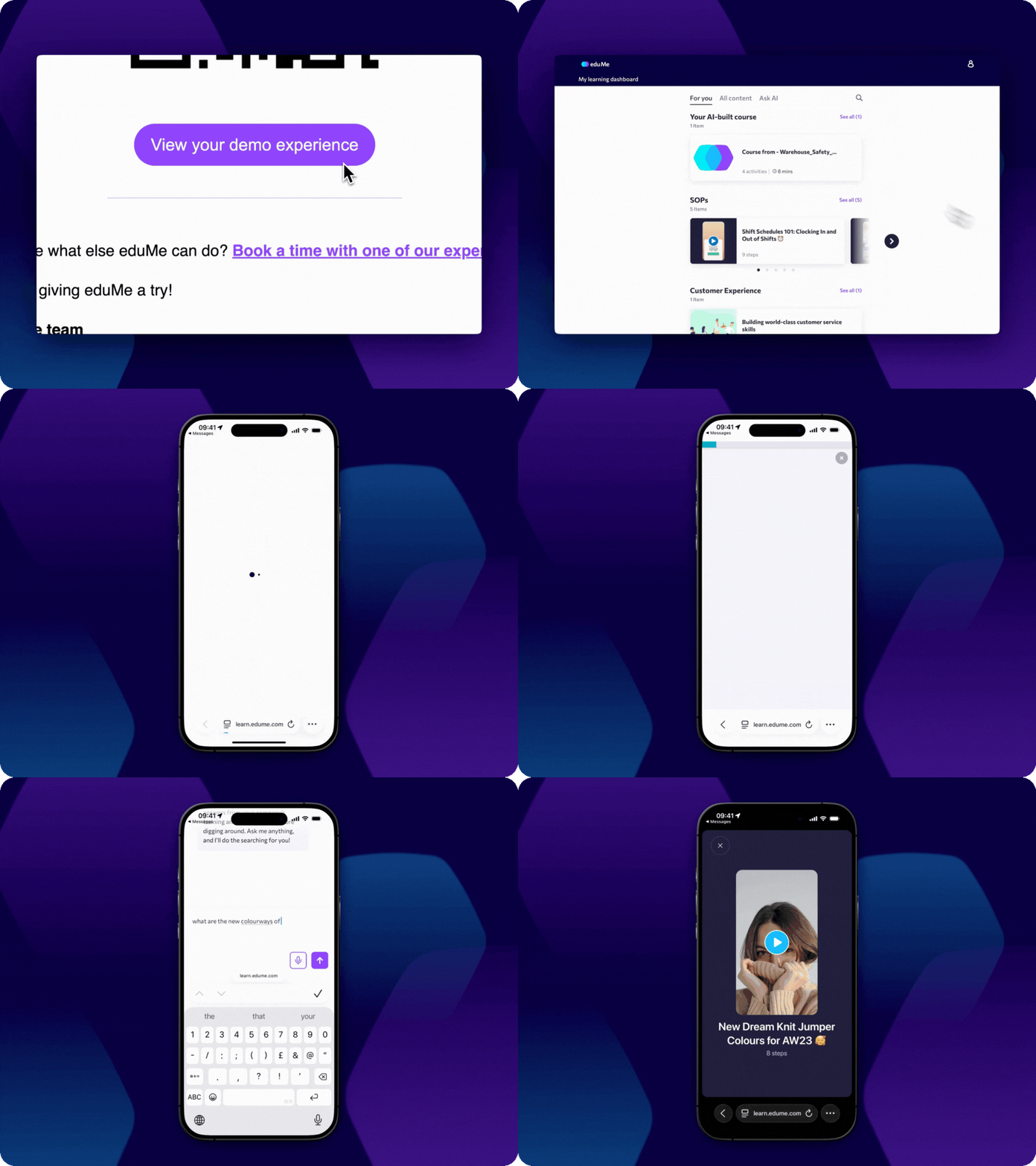
Experience eduMe in <60 seconds
No credit card required. No software to install. Just a hands-on preview of how frontline teams learn with eduMe.
Join 10,000+ frontline leaders
Subscribe to ‘Training the Frontline’ and get weekly insights sent straight to your inbox.