TABLE OF CONTENTS

A casino floor moves more money in an hour than most retail stores see in a month, and it moves through the hands of dozens of different roles at once. The commercial gaming industry generated $78.72 billion in revenue in the United States in 2025 alone, supporting 1.8 million jobs nationwide. Every dollar of that passes through a dealer, a cage cashier, a slot attendant, or a pit boss.
Add supercharged emotion, tense customer-to-customer interaction, and alcohol to that volume of cash, and you get a working environment unlike almost any other in the service industry. Staff work away from a desk and often away from a manager, much like their counterparts in warehousing, logistics, or retail. What sets casino floor staff apart is the interaction of all of these pressures at once, in a role that has to keep moving seamlessly regardless.
That combination is exactly why casino employee training cannot be one-size-fits-all. A pit boss needs different skills to a slot machine technician, and a host needs different skills to a compliance officer, even though they might work the same shift on the same floor. This guide covers what training each role actually needs, which parts of that training are non-negotiable, and how casinos are building a training strategy that covers all of it without pulling staff off the floor for days at a time.
What training do casino staff need?
Casino roles fall into two broad groups: the roles tied directly to gaming tables and machines, and the hospitality-adjacent roles that exist wherever a property includes a hotel or restaurant. A few roles sit above that split entirely, because their responsibilities cut across both.
The cage cashier handles chip and cash exchange and reconciliation, a role that touches nearly every transaction on the floor.
The host manages relationships with high-value guests, a highly customer-facing role built on service skill rather than gaming mechanics.
Host training tends to emphasize relationship management and discretion over technical gaming knowledge, since the role is judged on guest retention rather than table accuracy.
The shift manager, casino manager, or house manager oversees floor operations end to end, coordinating between departments that otherwise rarely interact.
On the floor
Floor roles are the ones most people picture when they think of casino work, and each carries its own distinct skill set.
The pit boss supervises the floorpersons, dealers, and games within their pit, and the job pulls in several directions at once: watching for security issues, managing staff performance, applying deep game knowledge, and stepping in to smooth things over when a guest and dealer disagree.. Pit boss training tends to build on several years of dealing experience first, since the role requires enough gaming knowledge to judge a dispute correctly at speed. Increasingly, pit bosses are also the casino's first line of defense against cheating and collusion, a responsibility covered in more depth below.
The croupier, or dealer, oversees individual table games including blackjack, roulette, craps, and poker. The role demands fast mental math, intimate knowledge of the specific game being dealt, and precise, fast shuffling and pacing. Roulette dealer training in particular focuses on wheel and ball mechanics, calling bets accurately, and paying out multiple winning combinations at once, all under time pressure.
Dealers are also trained to recognize common cheating methods such as card counting, past-posting, and collusion, since they are the closest set of eyes on every hand played.
The slot attendant provides front-line troubleshooting and customer assistance, and processes payouts.
Slot attendant training is customer-service-led first, with just enough technical grounding to resolve the machine issues that come up most often before deciding whether to escalate to a technician.
The slot machine technician is a distinct role from the supervisor, and one that's easy to overlook. Technicians own machine maintenance, repair, and troubleshooting, including hardware and software faults, jams, and payout mechanism issues.
An attendant will typically call in a technician when a problem goes beyond what can be resolved on the floor, which means technicians need training that goes far deeper into the mechanics of specific machine types than any other role on this list.
The slot supervisor oversees attendants and manages the slot floor, including staff scheduling and performance. This is a people-management role rather than a hands-on technical one.
Different state gambling laws add a further layer of variation on top of all of the above. A role in a New Jersey casino may carry slightly different licensing or reporting obligations than the same role in Nevada, which is one more reason a generic training approach doesn't hold up.
Hospitality
Where a property includes a hotel or restaurant, which varies significantly by casino scale, hospitality-adjacent roles sit alongside the gaming floor.
Front desk, food and beverage, and housekeeping staff all need casino hospitality training that looks much more like a standard hotel or restaurant operation, layered on top of the casino's own compliance requirements around things like responsible gaming awareness for any guest-facing role.
Casino housekeeping training in particular has to account for high-value items left in rooms, guest privacy expectations around a mostly-anonymous clientele, and reporting procedures if anything suspicious is found.
The table below summarizes the core responsibilities and training needs across all of these roles.
| Role | Key Responsibilities | Core Skills / Training Needs |
|---|---|---|
| Pit boss | Supervises dealers and floorpersons in a pit, resolves disputes | Supervisory skill, gaming knowledge, conflict resolution, cheating/collusion awareness |
| Croupier / dealer | Runs individual table games (blackjack, roulette, craps, poker) | Game-specific mechanics, mental math, pace, cheating-method awareness |
| Slot attendant | Front-line troubleshooting, customer assistance, payouts | Customer service, basic machine familiarity |
| Slot supervisor | Oversees attendants, manages slot floor staffing and performance | People management, scheduling, performance oversight |
| Slot machine technician | Machine maintenance, repair, and troubleshooting | Technical/mechanical skill, machine-specific diagnostics |
| Cage cashier | Chip and cash exchange, reconciliation | Cash handling accuracy, reconciliation procedures |
| Host | VIP relationship management, guest experience | Customer service, relationship management |
| Shift / casino manager | Oversees floor operations across departments | Cross-departmental coordination, operational oversight |
| Hospitality-adjacent roles | Front desk, F&B, housekeeping | Standard hospitality skills plus casino-specific compliance awareness |
Types of casino training
Not every training requirement carries the same weight. Some of it is legally non-negotiable. Some of it makes for a better-run casino without being mandated by any regulator. Understanding the difference matters, because a dealer error on the floor can create real legal liability for the casino, which is precisely why so much of this training isn't optional in the first place.
Casino compliance training
This is the umbrella for everything that's regulation-driven. It typically covers gaming regulations specific to the jurisdiction, anti-money laundering (AML) training required under federal Title 31 rules, licensing requirements for individual roles (most gaming-floor positions require a state-issued gaming license before someone can start work, renewed on a schedule set by the local gaming commission), responsible gaming training aimed at recognizing and supporting at-risk gamblers, surveillance training for monitoring the floor, and gaming protection training, which covers detecting cheating and fraud such as card counting, past-posting, collusion, and chip fraud.
Gaming protection sits closely alongside surveillance training in most casinos' compliance programs. Atlantic Cape Community College's Casino Career Institute, one of the longest-running dealer schools in the country, names games protection training as its own distinct offering alongside dealer training and surveillance.
Customer service, essentials, and hospitality training
Outside that compliance umbrella sit training areas that matter for a well-run floor without being tied to a specific regulation. Casino customer service training, including conflict resolution for tense moments at the table, keeps interactions from escalating before a pit boss or security needs to step in. A guest disputing a payout or accusing a dealer of a mistake is a near-daily occurrence on a busy floor, and how that first thirty seconds is handled shapes whether it stays a conversation or becomes a formal complaint.
Casino essentials training covers the operational basics of running a shift smoothly, from opening and closing procedures to etiquette expectations that don't rise to the level of formal compliance. Housekeeping and other hospitality-adjacent training applies wherever the property includes a hotel or restaurant.
The tension casinos face is that they're managing many roles at once, each with distinct daily responsibilities and non-negotiable knowledge requirements, spread across a workforce that's hard to reach because it's frontline, in a floor environment that's rarely calm enough for a long sit-down session. Given all of that, where does a casino actually start?
Covering all bases: a training strategy for casino management
No single training format covers everything above. The casinos getting this right are layering three distinct approaches, each one covering a gap the others leave open.
1. To qualify: certification
Some casino roles require certification before an application is even considered. Dealers are the clearest example: before applying to deal blackjack or roulette at most casinos, a candidate typically needs to complete a recognized casino training school or casino dealer training school first.
Crescent School in Las Vegas runs a 750-hour Comprehensive Dealing Program covering blackjack, roulette, poker, craps, and mini-baccarat.
In Atlantic City, Atlantic Cape Community College's Casino Career Institute has run dealer training for over forty-five years, making it the first licensed gaming school in the country affiliated with a community college .
Outside the US, Centro Formazione Croupier in Bologna, established in 1991, is the oldest international casino academy in Europe, with campuses across Italy and in Las Vegas.
Management roles have their own version of this step. A casino management training program qualifies candidates in supervisory, compliance, and operational fundamentals before they're considered for a pit boss or shift manager position. Certification is step one, not the whole strategy - it qualifies someone to start the job, but doesn't finish preparing them for it.
2. To refine skills: in-person observation
Formal schooling builds the foundation, but a large share of real skill refinement happens on the job, watching and being watched by someone more experienced. This matters most for roles with a strong technical or mechanical component.
A new slot machine technician learns fastest by watching someone experienced work through an actual fault on an actual machine, not by reading about it. A new dealer finds their pace under a pit boss's eye at the table, not in a classroom. A host learns how a particular property likes VIP relationships handled by shadowing someone who already does it well. None of this transfers cleanly to a document. It has to be shown, in person, at the equipment or the table where it happens.
The constraint is capacity. A manager or an experienced colleague can only be in one place at a time, and a casino running three shifts a day can't guarantee the same expert is free the second time a new hire hits the same problem.
That capacity gap is where on-the-job digital reinforcement and ongoing compliance training take over.
3. For reinforcement and re-compliance: casino eLearning
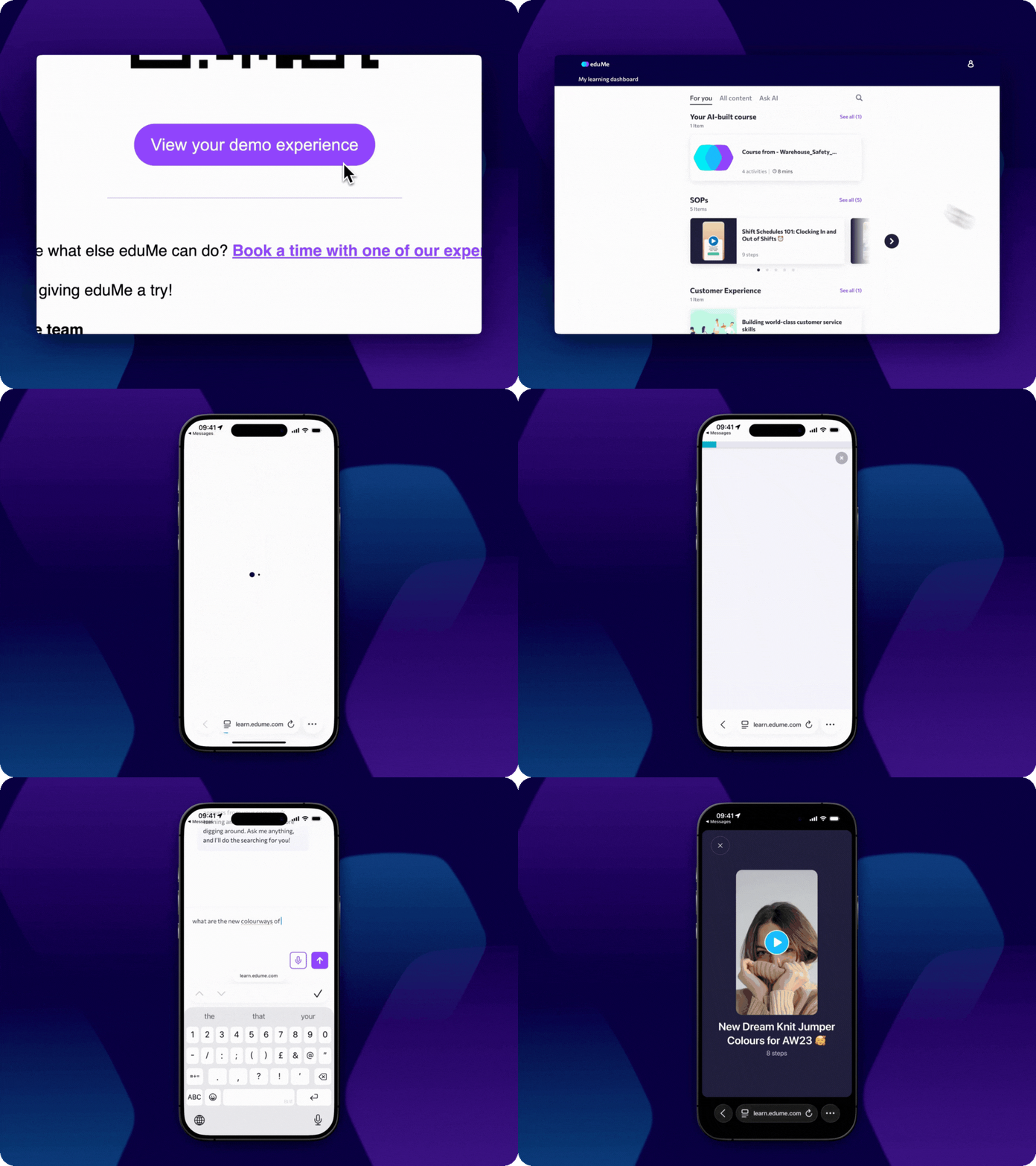
Rather than every new hire waiting on the one experienced technician to be free again, the fix they need to see gets filmed once. It's shot casually, closer to something a colleague would send in a group chat than a training video, cut into short steps a worker can tap through at their own pace, with captions running throughout for a floor that's rarely quiet enough to hear audio over. A new hire pulls it up on their phone mid-shift instead of waiting for someone to be free.
eduMe is a frontline enablement platform built to get training like this to the right person, in the flow of their actual shift. For compliance content specifically, eduMe's integration with OpenSesame gives casinos access to ready-made AML and responsible gaming courses without building certification content from scratch.
Delivery matters as much as content here. A QR code fixed to a slot machine can link straight to a role-based content library, so a technician or attendant gets exactly the guidance relevant to that machine without searching for it. For time-constrained staff, an Ask AI feature answers a question directly. A new slot attendant unsure how to process an unusual payout, with their supervisor unreachable, can simply ask and get a direct answer instead of guessing or leaving a guest waiting.
The result of that kind of reinforcement layer shows up in outcomes as well as completion rates. eduMe customers in comparable frontline, safety-driven environments have seen results like a 15 percent reduction in insurance claims following an eduMe rollout, worth roughly $250,000 in savings.
Casino employee training works best as a system, not a single event. Certification qualifies someone in, in-person observation sharpens what they do on the floor, and ongoing digital reinforcement keeps them consistent and compliant between the two.
That third layer is increasingly delivered as online casino slot machine technician training and similar digital modules precisely because it's the only layer that can reach a technician on a graveyard shift, in the moment they actually need it, without waiting for a classroom session to be scheduled.
Try eduMe for free to see how a frontline enablement platform fits into that system.
Experience eduMe in <60 seconds
No credit card required. No software to install. Just a hands-on preview of how frontline teams learn with eduMe.
Join 10,000+ frontline leaders
Subscribe to ‘Training the Frontline’ and get weekly insights sent straight to your inbox.