TABLE OF CONTENTS

Spotify knows what you want to listen to before you've decided. Netflix surfaces a film based on your watch history before you've thought to search. The algorithm doesn't just serve content - it knows you.
This level of personalization has yet to make it into the world of work - and into learning and development within it. 93% of frontline workers say they want training that"learns from them and evolves".
And organizations broadly understand that relevant training produces stronger outcomes, the question has always been: how do we roll out (and maintain) a program this intricate at scale?
The gap between what Spotify knows about you and what your LMS knows about you is not a technology problem - but a data and infrastructure problem. AI is the first thing to meaningfully change the equation.
The case for personalized training - before AI enters the picture
The argument for personalized training is not new. Lev Vygotsky's concept of the 'zone of proximal development' - the idea that learning is most effective when scaffolded just beyond a person's current capability level - has been foundational to learning theory since the 1930s.
Content pitched too far below what someone knows is wasted. Content pitched too far above it is overwhelming. Training that meets people where they are and moves them forward from there is demonstrably more effective.
The data supports this with some force. When asked what would most enhance their training experience, 59% of frontline workers chose "lessons based on my level, role, or specific knowledge gaps" - a result that outperformed every other option by a factor of two. A further 55% said that training which adapted to their previous behavior would "drastically" improve its effectiveness.
The problem is that the average training program ignores all of this. Research we ran found that 41% of information provided to employees is irrelevant to their specific role.
The downstream effect is measurable: workers spend an average of 2.5 hours a day searching for information that should have been surfaced to them in the first place. One-size-fits-all content doesn't just fail to engage - it actively costs time and attention that frontline operations cannot afford to lose.
This has always been the tension. Not a shortage of evidence that personalized training produces better outcomes, or failure of intent. The failure has been in execution - specifically, in the infrastructure required to make personalization work at scale.
Why it's never quite been achievable
Consider what delivering genuinely personalized training actually requires: an accurate picture of what each individual knows and doesn't know, which varies by role, tenure, location, and prior experience; a content library broad enough to serve different starting points; a sequencing logic that adapts to individual gaps rather than applying the same path to everyone; and a feedback mechanism that updates the picture as the person progresses.
In an organization with five employees, this is achievable through direct observation and conversation. In one with five thousand frontline workers across multiple sites and shifts, it breaks down.
The breakdown starts with the silo problem. Training creators build content - but 52% say their biggest disconnect is with the subject matter experts who hold the relevant knowledge. They rarely speak to local managers, who have the closest possible view of what skills gaps look like on the ground. 75% of those managers want more say in what their teams learn. 42% don't receive regular updates on how individuals are performing.
Content ends up built on assumption rather than established need - and the result is predictable: 63% of frontline workers say training regularly feels repetitive or irrelevant, and 48% say the most frustrating thing about training is that it "repeats stuff I already know."
Scale makes this worse in direct proportion to organizational size. More roles mean more distinct training needs. More sites mean more contextual variation. More turnover means more individuals at different starting points at any given time.
AI in L&D: 2026 Report
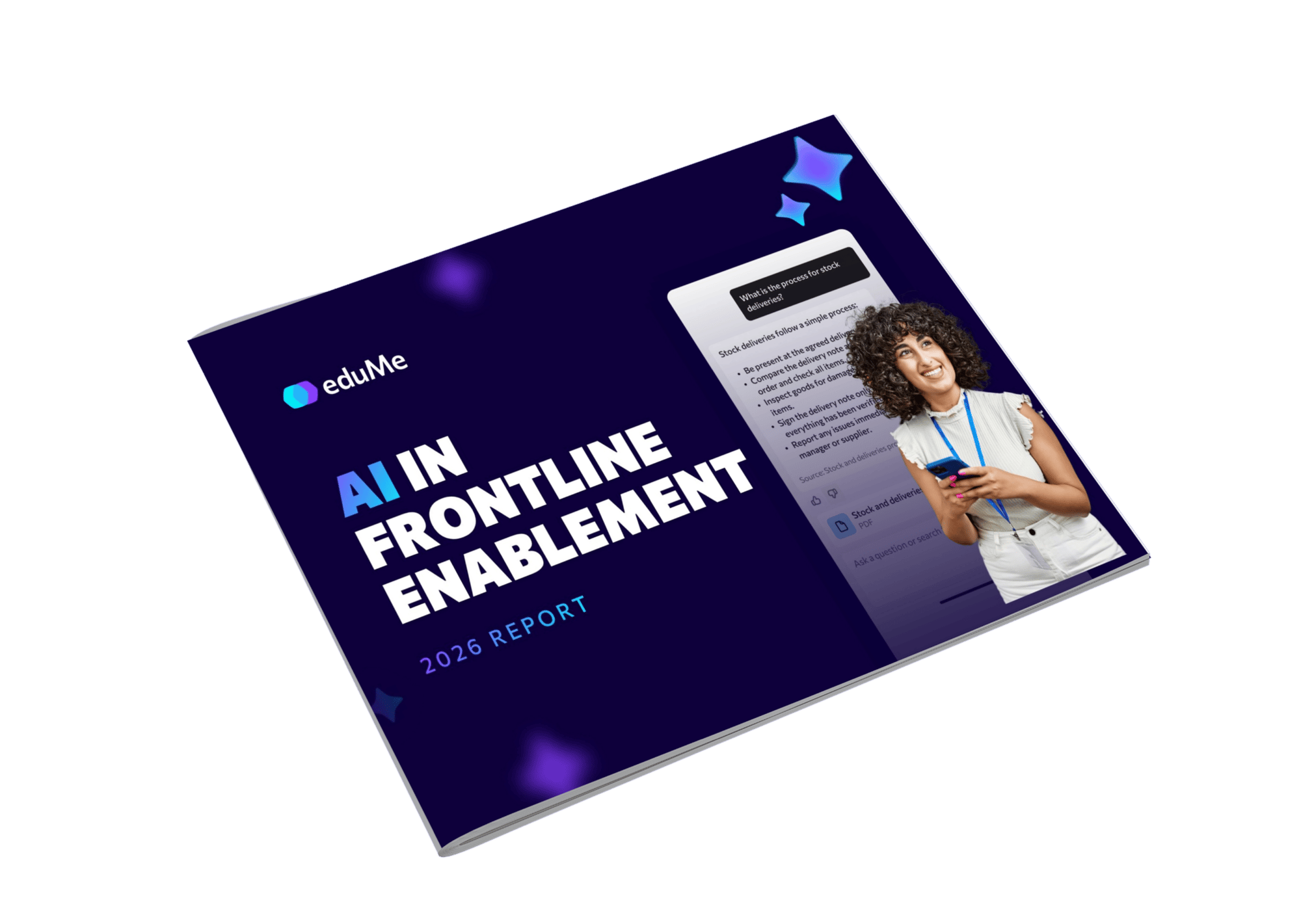
Discover how AI is reshaping L&D - according to 1,100+ people designing, delivering and experiencing training firsthand.
The surface area of what genuine personalization would need to cover grows faster than any team can manage manually. For most organizations today - where 58% of training creators still define audiences manually and only 10% have automated content distribution - personalization at scale isn't a gap in ambition. It's a gap in infrastructure.
The ideal world has been clear for some time. Everyone in L&D knows what good looks like: training that meets individuals where they are, builds on what they know, and adjusts as they progress.
The real world is a team of one, a platform with limited segmentation logic, and a manager on the floor who never gets to feed their observations back into the process. AI doesn't change the ideal world. It makes the real world closer to it.
Personalized, adaptive, suggested: a distinction worth making
Not all AI-enabled training experiences are equal, and the terminology is loose enough that the differences often get obscured. Before evaluating any tool in this space, it helps to know where on the spectrum it actually sits.
| Type | How it works | What the system knows |
|---|---|---|
| Suggested content | "You completed X, so here's Y" - content tagged as similar is surfaced. Useful for discovery, not personalization in any meaningful sense. | What you've done. Not what you need. |
| Personalized pathways | Path constructed based on role, prior completions, identified gaps, and starting level. Two people in the same building doing different jobs receive different sequences. AI handles assembly and gap detection; a person defines the outcome. | Your profile, your gaps, your starting point - used to build the path before and between sessions. |
| Adaptive learning | Content difficulty and sequencing adjust in real time within a session based on how someone is performing. If a module reveals a gap, the next piece of content responds immediately. | Your performance signal, in the moment - the highest bar, and genuinely different in kind from pathway personalization. |
Most tools claiming to deliver "personalization" are somewhere between the first and second of these. Most claiming to be "adaptive" are delivering the second, not the third. Knowing where a given tool sits on this spectrum matters when deciding what your organization actually needs.
AI's biggest opportunity isn't creation
Most conversations about AI in training start with content generation: faster course creation, automated translation, AI-assisted media. These capabilities matter, but framing them as AI's primary value proposition in learning misses the larger opportunity.
The harder problem - and the more consequential one - is orchestration. A typical frontline organization already has training resources: courses, guides, assessments, in-person session plans, compliance modules.
What it lacks is a system that connects these resources into sequences that map to specific outcomes for specific people, and updates those sequences as individuals progress and gaps emerge. This is an orchestration problem, and it is where AI has its greatest impact.
The operating model this enables is different from how training has historically been built. Rather than starting with the content available and assigning it by role, it starts with the outcome - "reduce picking errors among new warehouse starters," "certify operators on new production processes," "reduce time-to-competence for new store associates" - and assembles the path from there.
The content library becomes an input, not the starting point. AI identifies what exists, what is missing, and what sequence best supports the defined outcome for the individual in front of it.
This also reframes what AI personalization actually requires as infrastructure. The quality of the path is only as good as the data feeding it. Role and location pulled from an HRIS, prior completion history from the training platform, performance data from the floor - these inputs are what enable genuine individual-level personalization rather than educated guesswork at the role level.
HRIS integration isn't a technical nicety; it is the mechanism by which the system knows enough about the individual to personalize meaningfully.
What personalization looks like across modalities
A common misreading of AI-powered learning pathways is that personalization happens only in the digital layer - which module to assign next. This underestimates both the scope of the problem and the potential of the solution.
Effective training at the frontline rarely happens through digital content alone. Knowledge can be delivered digitally. Demonstrating a process can be done via video. But confirming that a machine operator can run equipment safely, or that a new store associate can handle a customer escalation without prompting, requires something different - in-person verification, coached practice, observation. A well-designed pathway accounts for all of these modalities as a sequence, not as separate initiatives.
Personalization across this full sequence means recognizing that different individuals reach the same verification checkpoint from different starting points, at different speeds.
One member of a new cohort may need two additional digital modules before in-person assessment. Another, with relevant prior experience, may be ready to demonstrate competence immediately. The path adapts to where each person actually is, not where the cohort is assumed to be.
The silo problem resurfaces here in a different form. Local managers - coaching on the floor, observing performance directly, running in-person check-ins - hold real-time insight into where individuals are struggling. But 42% receive no regular visibility into digital training performance, and 75% have no meaningful input into path design.
Systems that integrate data across both layers - digital completions and manager observations - close this loop. The picture of the individual becomes more accurate over time, rather than stagnating at the point of initial assignment.
What to look for in a tool
The gap between tools that claim AI personalization and those that deliver it is wider than most product pages suggest.
HRIS integration depth
The question isn't whether a tool integrates with your HR system - most will say they do. The question is what data flows across and how automatically. Role, location, tenure, and performance data that sync automatically and update when they change are what enable path personalization to reflect reality rather than a stale import.
Outcome-first configuration
Can you define what you want someone to be able to do, and have the system build toward that - rather than requiring you to sequence modules manually? The ability to describe the outcome and have AI construct the path from existing resources is the clearest signal that a tool is doing genuine orchestration rather than sophisticated content tagging.
Gap detection, not just path construction
Building an initial path from available resources is one capability. Identifying what's missing from the coverage of a defined outcome - and surfacing those gaps before they become performance problems - is higher-order, and genuinely valuable in frontline contexts where the consequences of training gaps are immediate.
Multi-format support
A tool that only handles eLearning modules can only personalize within those modules. Platforms that incorporate assessments, live training sessions, in-person verification tracking, and performance data alongside digital content can personalize across the full sequence.
Manager visibility
Personalization without feedback loops degrades over time. Local managers need visibility into individual progress, gap persistence, and assessment results to intervene early - and that visibility needs to be available without manual data-chasing.
The infrastructure argument is the personalization argument
The Spotify comparison isn't aspirational anymore. The technology to deliver training that learns from the individual - that knows their role, their gaps, their progression, and adapts accordingly - exists. The question that remains is whether the tools your organization uses are actually delivering it, or delivering the appearance of it.
Most aren't. Suggested content isn't personalization. A recommendation engine with a rebrand isn't AI orchestration. The distinction matters because the outcome difference between genuine personalization and content recommendation compounds over time - in time-to-competence, in engagement, in the gap between what your training program promises and what it produces.
The organizations closing that gap are the ones building the right infrastructure: HRIS integration, outcome-first path design, manager visibility loops. AI handles the assembly. The architecture is still yours to design.
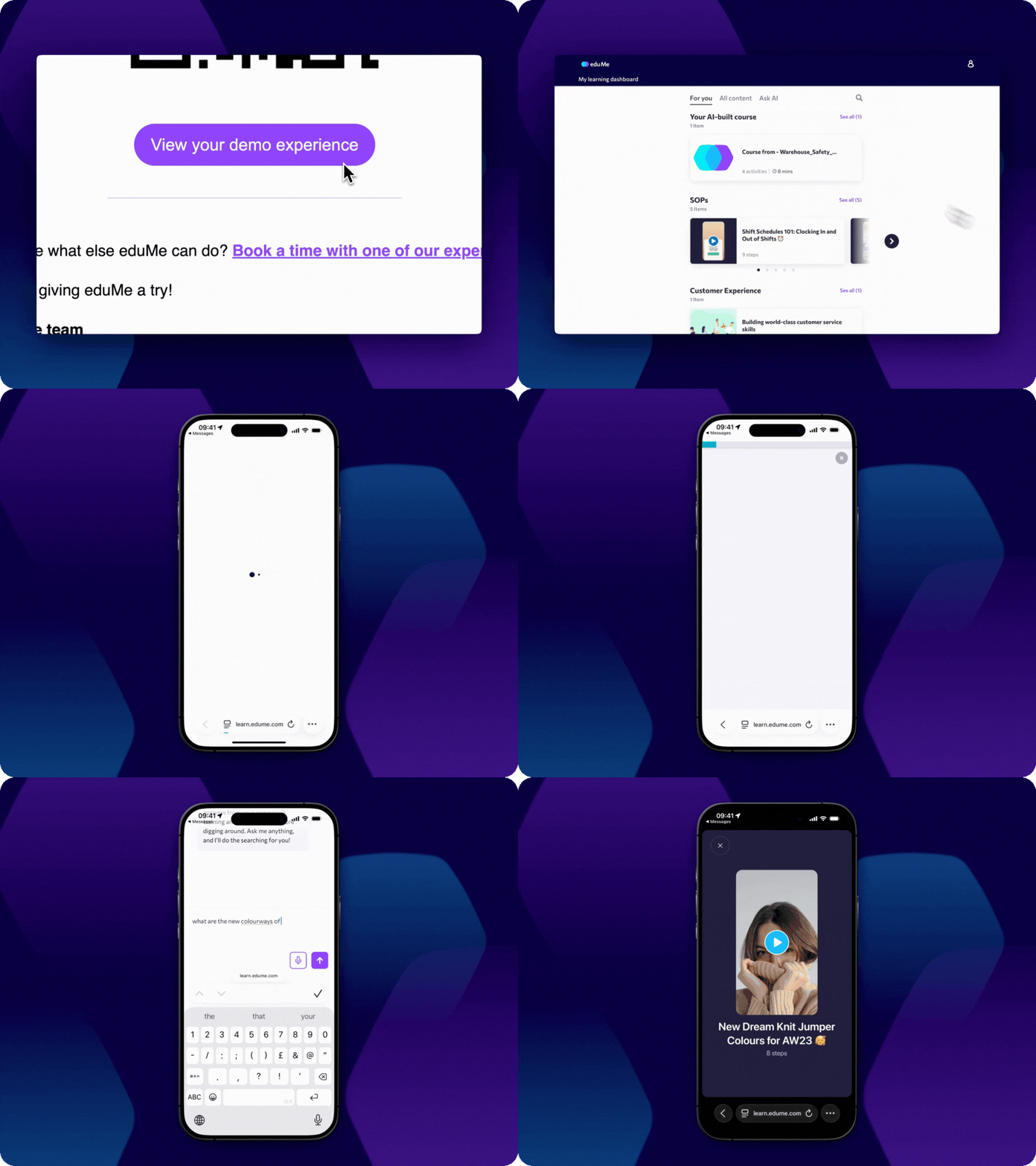
Experience eduMe in <60 seconds
No credit card required. No software to install. Just a hands-on preview of how frontline teams learn with eduMe.
Join 10,000+ frontline leaders
Subscribe to ‘Training the Frontline’ and get weekly insights sent straight to your inbox.