TABLE OF CONTENTS

Absorb LMS is widely used by organizations that need a structured, scalable way to manage formal learning. Its strengths in branding, certifications, and multi-audience training make it a common choice for enterprises running employee, customer, and partner programs.
As learning needs mature, many teams start to look at Absorb LMS alternatives. Sometimes that means evaluating a different enterprise LMS such as Docebo. In other cases, especially in frontline-heavy businesses, it means introducing (or switching to) a frontline enablement layer like eduMe that focuses on daily execution, rather than course delivery.
Here is how the three options compare at a glance:
| Platform | Primary role | Best suited for | Where it fits for frontline teams | Key trade-offs |
|---|---|---|---|---|
| Absorb LMS | Branded, course-based LMS | Employee, customer, and partner training | Useful for formal programs and certifications | Portal-based, learning is separate from daily workflows |
| Docebo | Enterprise learning platform with AI | Large-scale, multi-audience learning | Works for centrally governed programs | Heavier implementation, learning remains a destination |
| eduMe | Frontline enablement layer | Execution, guidance, operational consistency | Purpose-built for frontline delivery | Not a generic content library or full LMS |
Why Absorb LMS?
Absorb LMS is built around a central learning environment that combines structured programs, skills development, and supporting experiences like mentoring and content libraries. Learners access training intentionally, logging into a branded portal to work through defined programs, progression paths, or development activities over time.
This model assumes learning is planned and deliberate. Courses, coaching, certifications, and skill development are scheduled, tracked, and revisited, rather than delivered as short, in-the-moment prompts alongside daily work. That design supports consistency, governance, and long-term development, especially in organizations with clearly defined roles, frameworks, and expectations around growth.
Absorb’s strength lies in bringing these elements together - formal courses, skills frameworks, peer learning, and curated content - into a single system of record that can scale across teams and audiences.
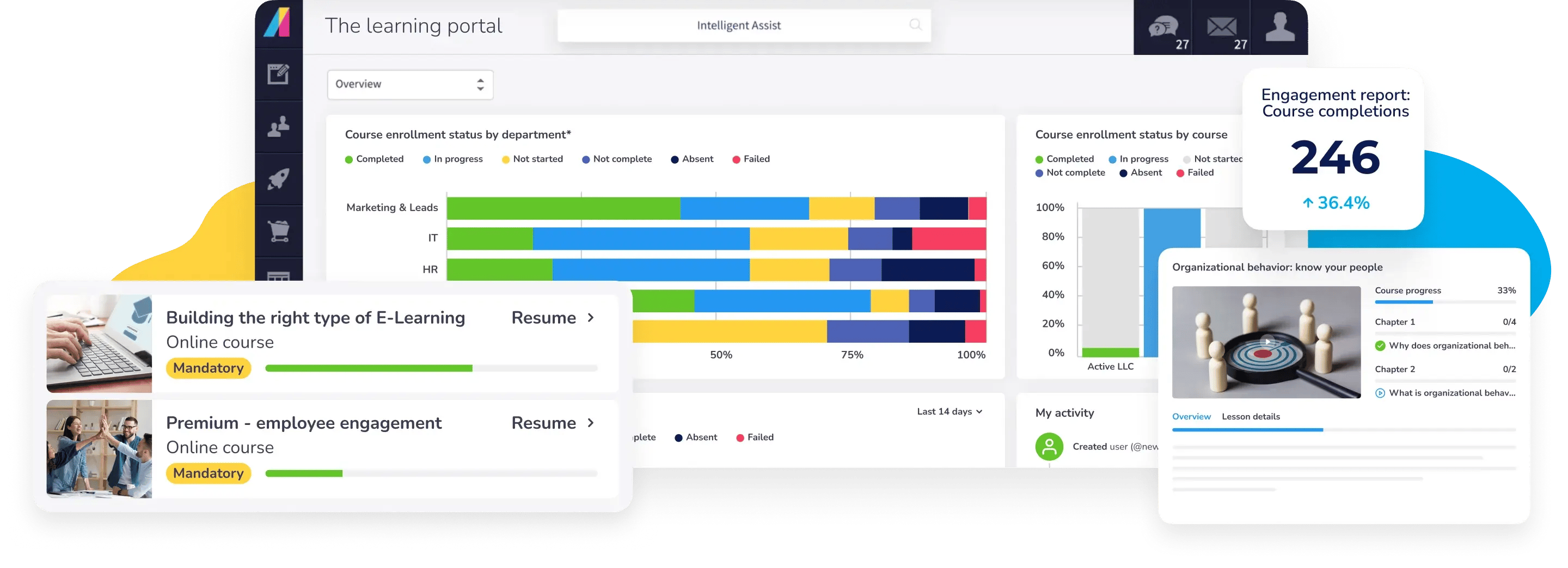
Absorb LMS learner dashboard, showing course progress, completion reporting, and portal-based navigation typical of enterprise LMS environments.
Absorb's branded learning portal
Branding is a headline part of Absorb’s value proposition. Teams are encouraged to “start by building a custom theme,” reflecting the expectation that the LMS functions as a standalone academy or learning center rather than a background system.
Portals can be tailored through elements such as
themes and color schemes, navigation layouts, homepage widgets including catalogs, transcripts, news, FAQs, and polls.This model suits environments where learners are expected to return to the LMS deliberately, for example to complete onboarding, renew certifications, or progress through formal development plans.
Peer-to-peer coaching and mentoring
Alongside formal learning and skills development, Absorb also supports peer-to-peer learning through mentoring and coaching workflows. These features allow organizations to run structured mentoring programs, match employees with coaches or peers, and track participation and outcomes over time.
Rather than relying on informal or ad hoc connections, mentoring can be treated as a first-class learning initiative. Employees can be matched based on role, skills, goals, or experience, while administrators retain oversight of participation, milestones, and engagement. Events, check-ins, and feedback loops can all be managed within the platform, keeping coaching connected to broader learning and development efforts.
This capability is particularly relevant in organizations where learning is as much social and experiential as it is content-driven. Absorb’s approach keeps mentoring tied to formal development structures, rather than positioning it as a separate or disconnected initiative.
Social and engagement features inside Absorb LMS
Beyond formal courses and skills frameworks, Absorb includes a set of engagement features designed to support social and collaborative learning within the platform. These include discussion spaces, news and bulletin-style updates, polls, leaderboards, and live collaboration elements such as breakout sessions and facilitated discussions.
This functionality exists to keep learners active and engaged via connection whilst they are inside the LMS. Whether that's asking questions of each other or checking leaderboards for their ranking. Collaborative sessions that complement the course catalog Absorb offers are available to support in 'live classroom' settings.
All this amounts to a rich learning environment that encourages learners to spend time on the platform. These features work fantastically for knowledge worker-roles, but less so for teams relying on quick, in-the-moment guidance and a work training software to dip in and out of.
Beyond the typical: Absorb as an 'eCommerce LMS'
Absorb LMS is not only used to train and develop employees inside large organizations. It is also used by individuals (or small training providers) who might want to package and sell their own courses.
In these scenarios, Absorb functions much like a branded online academy. Learners arrive intentionally, browse a course catalog, purchase access, and complete training over time inside a dedicated portal.
Progress, completions, and certifications are tracked in the same way they would be for internal learners, giving course creators a clear view of who has enrolled and finished each program.
This model suits long-form, curriculum-based training that learners actively choose to engage with - such as certification programs, premium product training, or subject-matter expertise courses.
Absorb’s built-in eCommerce features support this by handling payments, subscriptions, bundles, and access control in one place, reinforcing its role as a platform for delivering and selling training as a product rather than embedding guidance into day-to-day work.
Where Absorb LMS fits best
Absorb is a strong fit when learning programs share several characteristics, such as training being formal and program-based, tied to defined roles, skills or progression paths (as opposed to one-off knowledge checks).
Learners are expected to make time for development, whether for onboarding, certification, upskilling, or coaching.
It also works well when organizations need structure and visibility. Certifications, transcripts, compliance records, skill coverage, and participation in mentoring programs all matter, and leadership wants a clear view of how development is progressing across the organization.
As mentioned, the platform supports internal employees as well as consumers looking to independently upskill themselves via sold courses, and across both use cases branding plays a meaningful role in how the content is presented.
As such, Absorb LMS best suited to organizations (or individuals) looking to deliver structured development over the long-term.
Practical constraints to be aware of with Absorb LMS
The same design choices that make Absorb effective for structured programs can introduce friction for frontline teams.
Learning happens in a separate destination rather than inside the systems. And for organizations whose primary challenge is operational consistency rather than certification or external training, this separation can limit adoption.
Some teams address this by adding a frontline-specific layer on top of Absorb. Others, particularly when Absorb is used mainly for frontline training, replace it with a more execution-focused platform.
Absorb LMS pricing
Absorb offers a free trial to explore the platform. Pricing is not publicly listed and is provided through a sales-led process, typically based on learner volumes, configuration, and use cases such as customer education or ecommerce. More pricing information here.
Why some teams evaluate Docebo alongside Absorb
While Absorb and Docebo share core LMS capabilities, they diverge in how learning is expected to scale and evolve. Absorb is oriented around delivering structured programs through a branded portal, with an emphasis on clarity, presentation, and consistency. This makes it well suited to organizations that want learning to function as a stable destination for employees, customers, or partners.
Docebo takes a more modular approach. In addition to supporting formal courses and certifications, it places greater emphasis on automation, analytics depth, and platform extensibility. Learning journeys, skills frameworks, and reporting are designed to be configured and expanded over time, rather than remaining fixed once deployed.
Analytics is one of the clearest points of distinction. Absorb provides reporting to support oversight and compliance, whereas Docebo treats analytics as a configurable layer, with custom dashboards and evaluation tools aimed at understanding learning impact at scale. Integrations follow a similar pattern: both platforms connect to enterprise systems, but Docebo places more weight on automation apps, APIs, and optional add-ons that allow learning to sit more deeply within a broader ecosystem.
In practice, Absorb is often chosen for its simplicity and polished portal experience, while Docebo appeals to organizations that view learning as an evolving enterprise platform and are willing to invest in configurability over time.
Docebo as an enterprise learning platform
Docebo is typically adopted by large organizations delivering training across employees, customers, and partners. In day-to-day use, the platform is configured to automate workflows, personalize learning paths, and support skills-based development across diverse populations.
Alongside core LMS functionality, Docebo environments commonly incorporate AI-assisted content creation, skills mapping, multilingual delivery, and automated recommendations.
These capabilities reduce manual effort for L&D teams and support learning programs that need to scale and adapt.
Docebo learning management capabilities
At its core, Docebo supports the same LMS fundamentals as Absorb,these include:
- blended learning and ILT (support for online and instructor-led training)
- mobile-friendly access
- certifications and compliance tracking
- social learning and gamification
- course and program management
Where it differs is in the emphasis placed on capabilities such as:
- AI-powered content creation to build learning assets faster
- skills management, mapping training to skills and roles
- Harmony AI copilot to automate recommendations and workflows
- multilingual support with instant AI translation
These capabilities reinforce Docebo’s role as a system for scaling learning across large, diverse populations.
Docebo analytics, integrations, and add-ons
Docebo places significant weight on analytics and extensibility. Reporting can be customized through dashboards and evaluation tools, while automation apps, APIs, and integrations allow learning to connect more deeply with systems such as CRM, collaboration, and HCM platforms.
Optional add-ons extend the platform further, covering areas such as advanced analytics, virtual coaching, branded mobile experiences, extended enterprise domains, ecommerce, and workflow integrations. This makes Docebo suitable for organizations looking to consolidate multiple learning tools into a single configurable platform.
The result is a platform that can be configured for a wide range of formal learning use cases, especially in enterprises that want to consolidate multiple learning tools.
Where Docebo fits best
Docebo is typically chosen when:
- Learning is a strategic, enterprise-wide capability
- Multiple audiences (employees, customers, partners) must be supported from a single platform
- AI-driven personalization and automation are priorities
- L&D teams want to reduce manual administration and focus on design and impact
- Organizations are willing to invest in a configuration and ongoing optimization
Like Absorb, Docebo remains portal-centric: learning is accessed through the Docebo environment, even when embedded links and integrations are used to point learners toward it.
Docebo pricing
Docebo uses a tiered, sales-led pricing model.
- The Elevate package includes core learning management, AI-powered content creation, Harmony AI copilot, multilingual support, analytics, and a set number of integrations.
- The Enterprise package builds on this with more advanced analytics, additional integrations, extended enterprise domains, sandbox environments, branded mobile experiences, and enhanced support and API access.
Pricing is provided on request and scoped based on learner volumes, feature mix, and deployment complexity. More pricing information.
Where enterprise LMS platforms reach their limits on the frontline
Absorb and Docebo both excel at managing learning at scale. They provide the structure needed to organize courses and programs, assign training across large populations, track completions, and support certification and compliance reporting.
Their portal-based approach, combined with branding and role-based access, works well for both internal employees and external audiences such as customers or partners.
Frontline work, however, operates under a very different set of conditions.
Access to devices is often shared or constrained, time for training is fragmented into short, unpredictable moments, and learning needs to reflect highly specific internal processes, products, and standard operating procedures. In these environments, guidance is most valuable at the moment a task is performed, not days or weeks earlier as part of a scheduled course.
As a result, the expectation that workers will log into a learning portal, browse a catalog, and complete a course can be unrealistic. This does not make Absorb or Docebo ineffective. Rather, it highlights that enterprise LMS platforms are optimized for governing and scaling learning programs, not for supporting execution in the flow of frontline work.
How eduMe complements - or replaces - Absorb and Docebo for frontline teams
eduMe is designed as a frontline enablement layer that connects training, knowledge, and guidance directly to the work being done. It is often added alongside an existing LMS, but in frontline-heavy organizations it can replace an LMS that was primarily used for operational training.
Frontline-specific authoring and guidance
Teams use eduMe to create content around internal processes, site-specific workflows, product and SKU details, and safety and quality procedures. Content is quick to produce and update as operations change, rather than locked into long development cycles.
Embedded delivery inside daily workflows
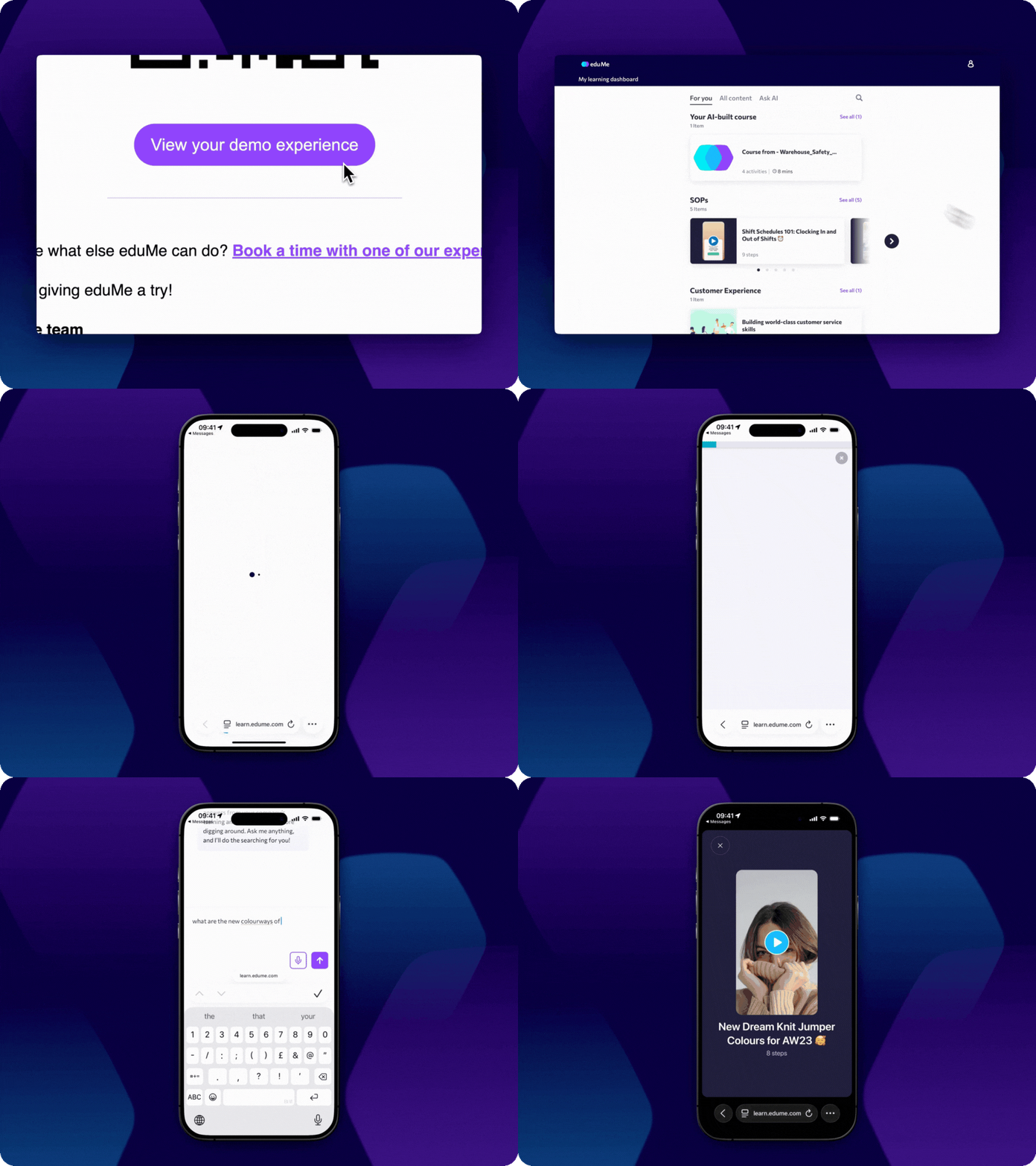
Instead of requiring learners to log into a separate portal, eduMe surfaces training through:
- shortcuts on shared devices
- embedded access within systems like Workday
- SMS, QR codes, and other entry points that match frontline reality
Training and guidance are delivered at the point of need, not just at the point of assignment.
From learning to execution
Where Absorb and Docebo focus on managing learning programs, eduMe focuses on reducing variation in how work is done, increasing readiness from day one, and improving consistency across locations.
For some organizations, this means running eduMe alongside Absorb or Docebo: the LMS remains the system of record for formal programs, while eduMe drives day-to-day execution on the frontline.
In others - especially where an LMS was used mainly for frontline training -eduMe replaces the LMS entirely.
Where eduMe fits best
eduMe is typically chosen when organizations need to:
- Reach frontline or deskless teams intuitively
- Train people on internal processes, products, and tools rather than generic topics
- Embed training and guidance into daily workflows
- Improve consistency and performance across sites
- Either complement an existing LMS or simplify a stack that is over-weighted toward formal learning for frontline roles
eduMe pricing
Organizations typically start with a core platform package that supports frontline training, knowledge distribution, and workflow-embedded guidance.
Pricing then scales based on the size and complexity of deployment, such as the number of sites, regions, or operational use cases covered. More information available on eduMe's pricing page.
Final verdict: choosing between Absorb, Docebo, and eduMe
These platforms are not interchangeable, and in some organizations they are even co-used rather than treated as like for like replacements.
So - which best suits you?
- Choose Absorb LMS if you need a branded, course-based platform for structured employee, customer, or partner training, with options to certify and even monetize learning through a portal.
- Choose Docebo if you are consolidating enterprise learning across multiple audiences and want AI-driven personalization, automation, and analytics at scale.
- Opt for eduMe when training needs to reach frontline teams intuitively, reflect your own processes and products, and support execution inside daily workflows. In frontline-heavy organizations where a traditional LMS is used mainly for operational training, eduMe may replace an LMS entirely.
The right choice depends less on which feature list looks strongest on paper, and more on where learning needs to live: in a branded destination, in a consolidated enterprise platform, or directly in the work your frontline does every day.
Experience eduMe in <60 seconds
No credit card required. No software to install. Just a hands-on preview of how frontline teams learn with eduMe.
Join 10,000+ frontline leaders
Subscribe to ‘Training the Frontline’ and get weekly insights sent straight to your inbox.