TABLE OF CONTENTS

Most organizations already have compliance training.
They have onboarding modules, annual certifications, SOP documentation, safety walkthroughs... They have an LMS with records that show which workers completed required training on time. And yet, operational inconsistency still creeps in.
A warehouse team develops shortcuts during peak demand. A manufacturing process starts being handled slightly differently across shifts. A safety procedure gets interpreted one way by supervisors and another way by operators. New hires learn faster from shadowing experienced workers than from the training itself.
This is the problem many frontline organizations are now confronting, and what we discuss in our latest eBook: Safety & Compliance Training for Frontline Teams.
This piece explores how organizations are restructuring frontline workforce training around reinforcement, operational visibility, competency validation, and continuous learning systems that support employees directly in the flow of work.
No time to read? Scroll on for its 6 main takeaways.
1. Frontline compliance training works best when operational guidance sits alongside foundational learning
Most organizations still need standardized compliance training. Regulatory frameworks, accredited courses, OSHA guidance, food safety certifications, and workplace safety training programs all play an important role in establishing baseline knowledge across frontline teams.
The problem is that frontline environments are rarely as standardized as the training itself.
A warehouse safety training process may need to account for different traffic flows, layouts, staffing pressures, or equipment configurations between facilities. Manufacturing safety training often varies heavily depending on machinery, production setup, and how work actually moves through a plant day to day. Even something relatively straightforward, like lockout/tagout procedures, can end up being handled differently across sites once operational reality enters the picture.
This is usually where the disconnect starts.
Workers complete the required learning, but struggle to connect policy back to the conditions they actually deal with on shift. The training may technically be correct while still feeling detached from how work happens in practice.
Workers can usually tell within minutes whether training was built around the reality of the job or around a policy document sitting in head office.
BorgWarner approached this differently while reinforcing safety procedures across manufacturing operations. Teams built training around the actual plant environment itself, using real equipment, real operational workflows, and familiar frontline employees within the learning experience. Instead of separating training from operational reality, the two became much more closely connected.
That familiarity matters. Employees are far more likely to pay attention when the examples, equipment, and working conditions reflect the environment they already know.
This is also why many organizations are moving toward blended frontline learning ecosystems that combine foundational compliance education with operational reinforcement and role-specific enablement.
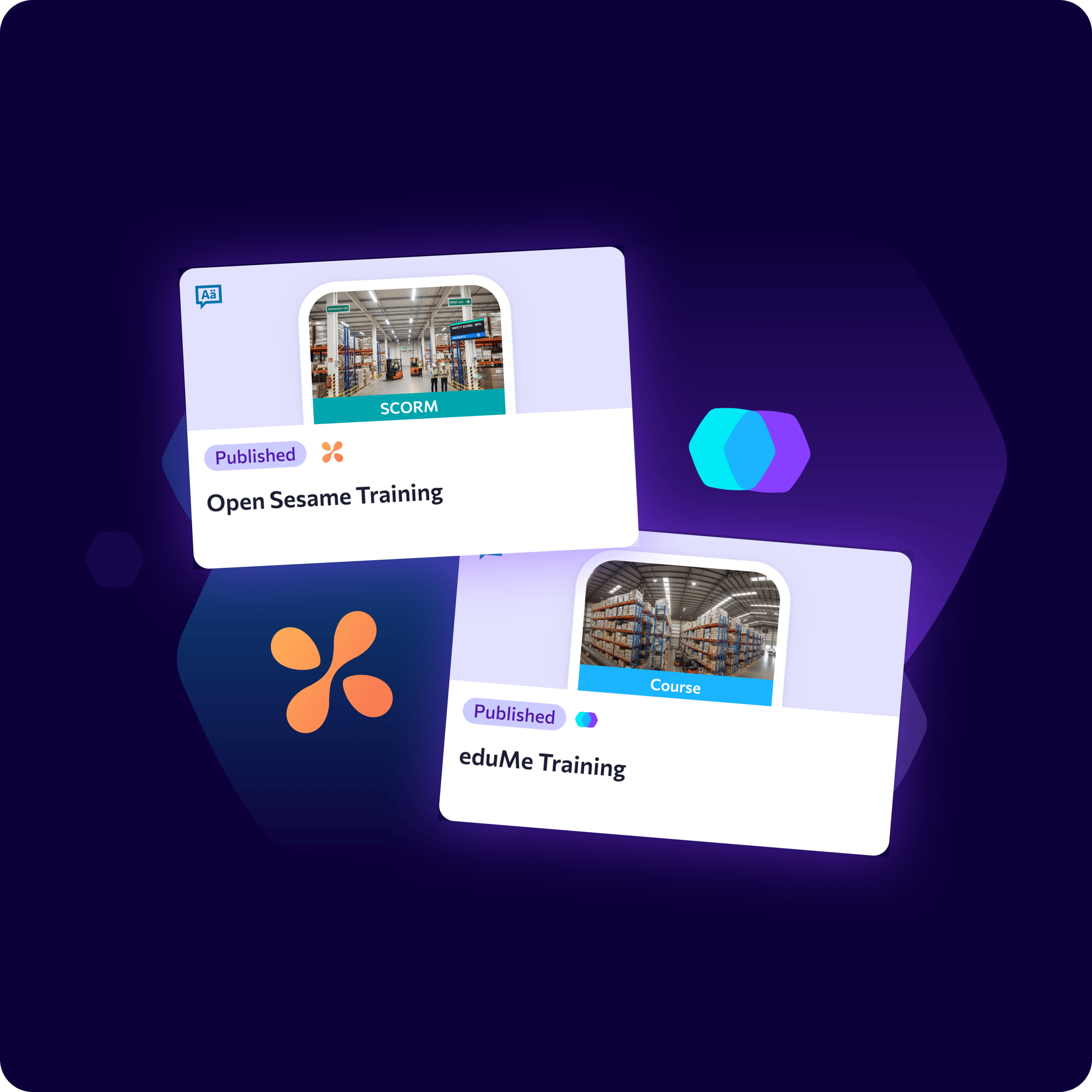
OpenSesame + eduMe
Combine standardized compliance training with mobile-first frontline enablement in one connected learning experience.
2. Safety training systems need to keep pace with operational change
One of the biggest weaknesses in traditional safety training management is how slowly learning systems adapt compared to the operation itself.
Procedures evolve constantly across manufacturing, logistics, warehousing, and frontline operations more broadly. Equipment changes. Processes shift. New risks emerge. Local workarounds appear. But updating training content often still involves a long chain of manual coordination that struggles to keep pace with operational reality.
An SOP changes and suddenly somebody needs to rewrite documentation, rebuild the lesson, update translations, source visuals, upload content into multiple systems, notify managers, and roll everything out before teams start developing inconsistent ways of working on the floor.
Meanwhile, the operation itself keeps moving.
DrinkPAK faced this challenge while scaling manufacturing operations rapidly across multiple production facilities. Training needed to stay current as workflows evolved, but the business also needed frontline guidance to remain accessible across a fast-growing workforce.
This is where AI is becoming operationally useful inside frontline workforce training environments.
The organizations seeing the most value are not simply using AI to generate generic content faster. They are using it to reduce the lag between operational change and frontline guidance deployment.
Existing SOPs can be turned into mobile-first microlearning. Safety documentation can be simplified for frontline delivery. Lessons can be adapted faster for different sites, roles, or languages. Guidance evolves alongside operational processes instead of months afterward.
BorgWarner used AI-assisted workflows to speed up content creation while still keeping training highly specific to the realities of each site. Existing materials could be uploaded, adapted conversationally, and enriched with company-specific imagery and media.
This is one reason AI-generated safety training is becoming more relevant operationally. Not because organizations want less human involvement in training design, but because frontline operations change too quickly for static content maintenance models to keep up consistently.
3. Compliance training loses effectiveness when reinforcement disappears
Most workplace safety training programs are still structured around isolated learning events.
Employees complete frontline onboarding training. Certifications get renewed annually. Refresher modules appear before audits. Then the organization assumes the knowledge will hold.
Frontline environments rarely work that way.
Operational behavior changes gradually through repetition, environmental pressure, habit formation, and observation. Experienced workers start relying more heavily on muscle memory over time. Teams develop shortcuts to maintain throughput. New hires often learn just as much from watching coworkers operate on shift as they do from formal training itself.
This is one reason safety training retention becomes such a challenge across deskless workforce training environments.
Flagger Force, a traffic control company operating thousands of active roadside jobs, approached reinforcement differently. Rather than relying entirely on classroom instruction, the company introduced continuous digital reinforcement between in-person sessions. Quiz questions resurfaced at intervals to prompt recall and strengthen retention over time. Roleplay scenarios helped employees practice how to respond to difficult real-world situations before encountering them live on the job.
Importantly, those scenarios were filmed using the company’s own employees and operational environments. The training felt recognizable because it reflected situations workers actually encountered in the field.
That matters because reinforcement works very differently when learning stays connected to operational reality.
Organizations improving frontline safety outcomes are increasingly operationalising compliance training rather than treating it as a standalone requirement. Guidance remains visible after onboarding ends. Reinforcement happens continuously instead of once a year before an audit. Workers revisit procedures during the work itself rather than outside it.
Over time, that creates a much stronger connection between training and day-to-day execution.
4. Accessibility directly affects whether frontline learning gets used
Many frontline learning systems still assume employees have uninterrupted desktop access, spare time to navigate multiple systems, and enough operational flexibility to search for guidance when they need it.
Most frontline environments look nothing like that.
Warehouse workers move constantly between tasks. Manufacturing employees rotate across shifts. Logistics safety training often needs to support workers operating across loading bays, vehicle fleets, distribution centers, and high-pressure operational environments where speed matters.
In those settings, every additional layer of friction reduces the likelihood that guidance gets revisited consistently.
DrinkPAK addressed this directly by distributing learning through multiple operational channels simultaneously. Employees could access training through Workday notifications, Microsoft Teams, internal systems, and QR codes placed directly onto machinery and operational equipment.
Those QR codes took operators straight into process-specific training at the point of relevance.
That sounds simple, but operationally it changes the role learning plays.
Instead of requiring workers to stop what they are doing and search for information elsewhere, guidance becomes embedded much closer to the work itself.
This is one reason mobile safety training and mobile-first frontline learning platforms have become increasingly important across deskless workforce training environments. The closer operational guidance sits to execution, the more likely workers are to use it when they actually need support.
5. Completion data tells organizations very little about real operational competency
Most frontline learning systems are still very good at measuring exposure to training and surprisingly weak at measuring whether somebody can actually perform safely on shift.
Completion rates, attendance records, certifications, and knowledge-based assessments still matter operationally. But they can also create a false sense of workforce readiness when organizations rely too heavily on them in isolation.
A worker may pass a safety assessment and still struggle to execute the process correctly during a live shift while balancing production pressure, interruptions, fatigue, changing environmental conditions, or conflicting operational priorities.
That gap becomes particularly visible in manufacturing safety training and warehouse safety training environments where procedural consistency directly affects worker safety and operational continuity.
This is why more organizations are moving toward competency-based training and observational assessments for frontline workers.
The shift is subtle but important. Instead of asking whether training was completed, organizations are increasingly asking whether workers can consistently demonstrate the required skill under real operating conditions.
BorgWarner approached this by introducing in-person assessments directly on the manufacturing floor. Operators were evaluated against real tasks in working environments, with those observations feeding back into a broader operational view of workforce readiness.
Managers could see not only who had completed training, but whether skills had actually been demonstrated consistently in practice, where reinforcement was needed, and where capability gaps were beginning to emerge operationally.
That creates a much more useful picture of frontline readiness than completion records alone.
6. Frontline managers need visibility into workforce readiness, not just completion records
Frontline managers are usually closest to operational performance while simultaneously having the least visibility into how workforce capability is evolving over time.
Training records sit in one system. Compliance data sits somewhere else. Operational issues show up locally on the floor first. Managers are left trying to work out whether inconsistent execution reflects knowledge gaps, reinforcement issues, process drift, or operational pressure within specific teams.
That becomes difficult quickly across distributed frontline operations because performance rarely deteriorates all at once.
More often, inconsistency develops gradually through uneven reinforcement, local shortcuts, shifting habits, or differences between sites and supervisors. By the time issues become formally visible, the underlying drift may already have been happening operationally for weeks or months.
BorgWarner approached this challenge by combining training visibility with observational validation happening directly on the shop floor. Managers could monitor who was progressing, who was getting stuck, and where operational support was required.
That broader operational visibility matters because workforce readiness is rarely static. Capability shifts over time. Procedures drift. Reinforcement weakens. New risks emerge.
The organizations improving frontline safety outcomes most consistently are usually the ones with the clearest operational view of how learning, reinforcement, and real-world execution connect together day to day.
Final thoughts
Most organizations already have frontline safety training content.
The harder challenge is maintaining operational consistency once employees return to the floor and real working conditions begin shaping behavior again.
This is why many organizations are restructuring how frontline compliance training works altogether. Learning is becoming more continuous, more accessible, more operationally embedded, and more closely connected to frontline execution itself.
Training alone rarely changes operational behavior permanently.
Reinforcement, accessibility, manager visibility, competency validation, and operational relevance are what help procedures hold up over time in real frontline environments.
That shift is changing how organizations approach workplace safety training programs, workforce readiness, and operational compliance at scale.
If you want to explore the full framework in more depth, download our guide: Safety & Compliance Training for Frontline Teams.
eBook: How to Improve Safety & Compliance for Frontline Teams
Learn how to build safety and compliance training that supports retention, real-world application, and on-the-job verification..
Join 10,000+ frontline leaders
Subscribe to ‘Training the Frontline’ and get weekly insights sent straight to your inbox.