TABLE OF CONTENTS

AI is quickly becoming embedded in learning and development. From content creation to data analysis and workflow automation, it’s now part of almost every stage of the training process.
The promise is clear: faster production, easier scaling, and more efficient delivery.
But speed alone doesn’t guarantee better outcomes.
Across many organizations, training is still completed but not applied. Content is created, but not always used. And despite increased investment, the link between training and real-world performance remains unclear.
That raises a more important question: where is AI actually making a difference?
To understand the current state of AI in L&D, we surveyed over 1,100 frontline workers, managers, training creators, and senior leaders across industries including retail, hospitality, manufacturing, and logistics. Several patterns emerged quickly:
-
93% of frontline workers want enablement that adapts to them over time
-
84% would prefer to find answers themselves using AI-powered support
-
92% are looking for guidance that fits directly into their workflow
-
79% of training creators say working with SMEs slows them down
Taken together, these findings point to a broader shift. Improving training content is no longer enough on its own. The way training is accessed, updated, and applied in real work is becoming just as important.
In the sections below, we explore the key trends shaping AI in learning and development, and what they mean for organizations looking to turn training into measurable performance.
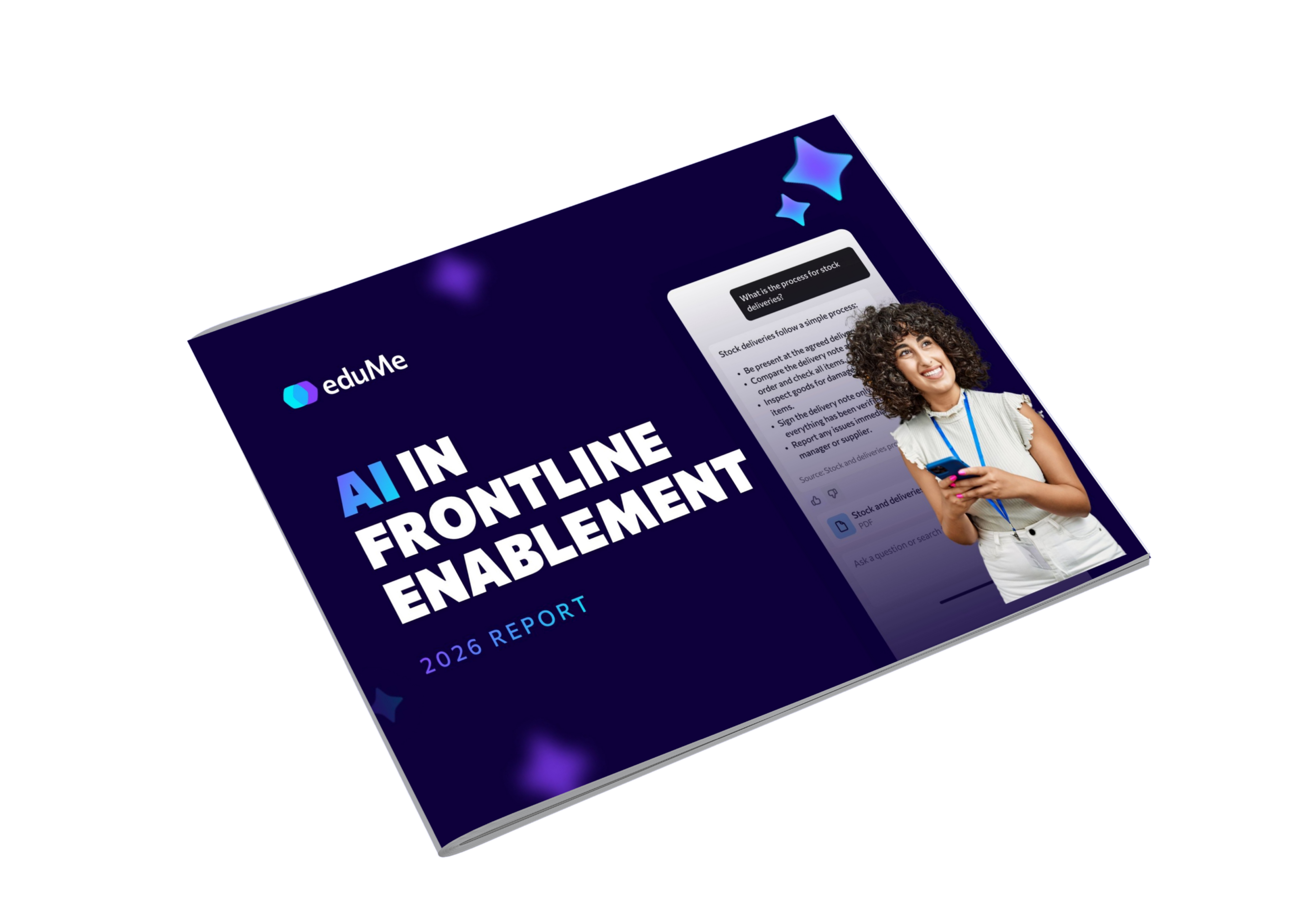
AI in Frontline Enablement: 2026 Report
Trend 1: Personalization is no longer enough
For years, personalization has been treated as a benchmark for effective training.
But expectations have moved on.
Frontline workers are increasingly looking for enablement that evolves alongside them. 93% say they want training that reflects their experience, performance, and development over time, while 84% say they would prefer to self-serve answers directly from training content using AI.
This goes beyond assigning content based on role or location. It points to a need for systems that respond dynamically, adjusting not just what is delivered, but how and when it is accessed.
One of the clearest shifts is in how workers expect to interact with training content itself. 92% say they want guidance that fits directly into their workflow, without interrupting the task at hand.
At NexusTours, frontline teams no longer need to search through modules or rely on managers to find answers. Instead, they can ask a question and receive an instant, contextual response through an AI chatbot connected to their training content.
This has changed how knowledge is used day to day. Rather than completing training and moving on, employees can access what they need in the moment, reducing delays and removing dependency on supervisors.
This is a practical example of how using AI in learning and development is evolving. The focus is shifting from delivering personalized content to enabling individualized access to knowledge.
In fast-changing environments, this distinction matters. Static learning paths quickly lose relevance. What workers need is the ability to retrieve and apply knowledge as situations change.
How can you move beyond personalization?
Focus on access as much as assignment. Ensure employees can quickly retrieve relevant information when they need it, and consider how AI can support more responsive, conversational ways of interacting with training.
Trend 2: Org-level consistency depends on frontline alignment
Consistency is a priority across most frontline organizations.
But achieving it is rarely straightforward.
While training is typically designed centrally, performance plays out locally, across different teams, shifts, and environments. That gap creates challenges, particularly when local managers do not have full visibility into how their teams are learning or performing.
42% report limited access to regular performance updates, and 75% would like more insight into how training is landing with their teams.
At the same time, frontline workers themselves report inconsistent experiences, with many relying on informal knowledge-sharing methods rather than standardized guidance, reinforcing the variability across teams.
Without that visibility, managers are left to react rather than proactively guide performance.
This is where many AI and learning and development strategies fall short. They focus on content delivery, but not on how performance is measured and fed back into the system.
BorgWarner faced this exact challenge. Operating complex manufacturing environments, they needed a way to ensure safety and process training was not just completed, but consistently applied across shifts and teams.
By combining on-the-ground validation with centralized visibility, local managers were able to verify skills in real working environments and feed performance gaps back up to leadership. This created a tighter feedback loop between training and execution, ensuring consistency was not assumed, but measured and reinforced.
The result was a 97% safety training completion rate, alongside a measurable reduction in safety incidents on the shop floor.
How can you improve consistency?
Give managers access to real-time performance data, and ensure they play an active role in validating skills, not just delivering training. The more directly performance feeds back into your training model, the more consistent outcomes become.
Trend 3: Access in the moment matters most
For many frontline teams, the issue is not whether training exists, but whether it is usable in practice. 49% of leaders say training is too difficult to access or use to have a meaningful impact.
This friction shows up in how workers retrieve information day to day. When they need answers, 45% ask a colleague and another 45% search internal systems, rather than returning to formal training.
In other words, access breaks down at the point of need.
Crate & Barrel faced this challenge across a large, distributed retail workforce, where many associates did not have email access and relied on managers to cascade information.
By introducing multiple access points, including integration with Workday, in-store devices, and contextual QR codes, they made training available directly within the flow of work.
This shift reduced reliance on managers and made knowledge consistently available at the point of need, rather than tied to scheduled sessions or communication chains.
How can you enable learning in the flow of work?
Focus on reducing friction. Deliver training through systems your workforce already uses, and ensure employees can access what they need quickly, without navigating multiple tools or relying on intermediaries.
Trend 4: Training creators are under pressure
Behind every training program is a team responsible for building and maintaining it.
And for many organizations, that process is still heavily manual.
Training creators spend significant time identifying content gaps, sourcing information, and refining materials. 79% say working with SMEs is a key bottleneck, while 56% report spending time deciding who should receive training, and 50% are focused on reviewing lesson quality.
This highlights a broader issue across the current AI in L&D report 2026 landscape. The challenge is not demand for training, but the ability to produce and maintain it at scale.
Temco Logistics experienced this firsthand as they rapidly expanded their workforce across the U.S. With thousands of frontline workers operating remotely, traditional in-person training quickly became unsustainable.
Their approach shifted from relying solely on centralized content creation to enabling user-generated content across the workforce. By encouraging drivers and technicians to share their own expertise, Temco was able to scale knowledge quickly while making training more relatable and practical.
This peer-led model, combined with AI-supported content creation, significantly reduced pressure on central L&D teams while improving engagement and consistency. The impact was measurable, including a reduction in accident rates and $600,000 in cost savings.
A similar pattern can be seen at NexusTours. By combining AI-assisted content creation with faster knowledge access, they were able to reduce reliance on manual processes while improving the speed at which training could be created and used.
This is where AI in L&D moves from talk to action. It is not just about generating content, it is about distributing the responsibility for knowledge creation across the organization.
How can you support training creators?
Reduce reliance on centralized production. Use AI to accelerate content creation, and create pathways for employees and SMEs to contribute directly. The more distributed your content model becomes, the easier it is to scale.
Trend 5: AI is shifting from speed to impact
Much of the early conversation around AI in L&D focused on efficiency -faster content creation, easier updates, reduced manual effort.
But for many organizations, that is no longer the primary measure of success.
Frontline workers are clear about what they expect from training. 93% say they want enablement that adapts to them and supports their development over time.
This reflects a broader shift. The focus is moving away from how quickly training can be produced, and toward whether it drives measurable outcomes in real work.
Across industries, there are early examples of what this looks like in practice.
At Pet Supermarket, improvements in training accessibility and engagement translated into operational impact, including a $1 million reduction in perishable inventory loss.
At Flagger Force, reinforcing training through accessible, in-flow delivery contributed to a 60% reduction in heat-related incidents and a 15% reduction in insurance claims.
In both cases, the value of training is not measured by completion rates alone, but by its effect on performance.
This is where AI is beginning to have the greatest impact. Not just by accelerating production, but by supporting better decisions, reinforcing knowledge in context, and enabling more consistent execution across the workforce.
How can you approach AI adoption?
Focus on outcomes, not just efficiency. Identify where improved access, reinforcement, or visibility could influence performance, and prioritize those use cases first.
AI in frontline enablement: Final thoughts
Across frontline workers, managers, and L&D leaders, there is a shared expectation.
Training should work in practice, not just in theory.
This is reflected across the broader state of AI in HR and learning trends. Organizations are moving beyond experimentation, and focusing on how AI can directly improve performance outcomes.
That means enabling people to apply what they have learned, access support when they need it, and continuously improve over time.
AI is accelerating progress in each of these areas. But its impact depends on how it is applied.
The organizations that benefit most will be those that use AI to strengthen execution, ensuring training is not only delivered, but used effectively in the flow of work.
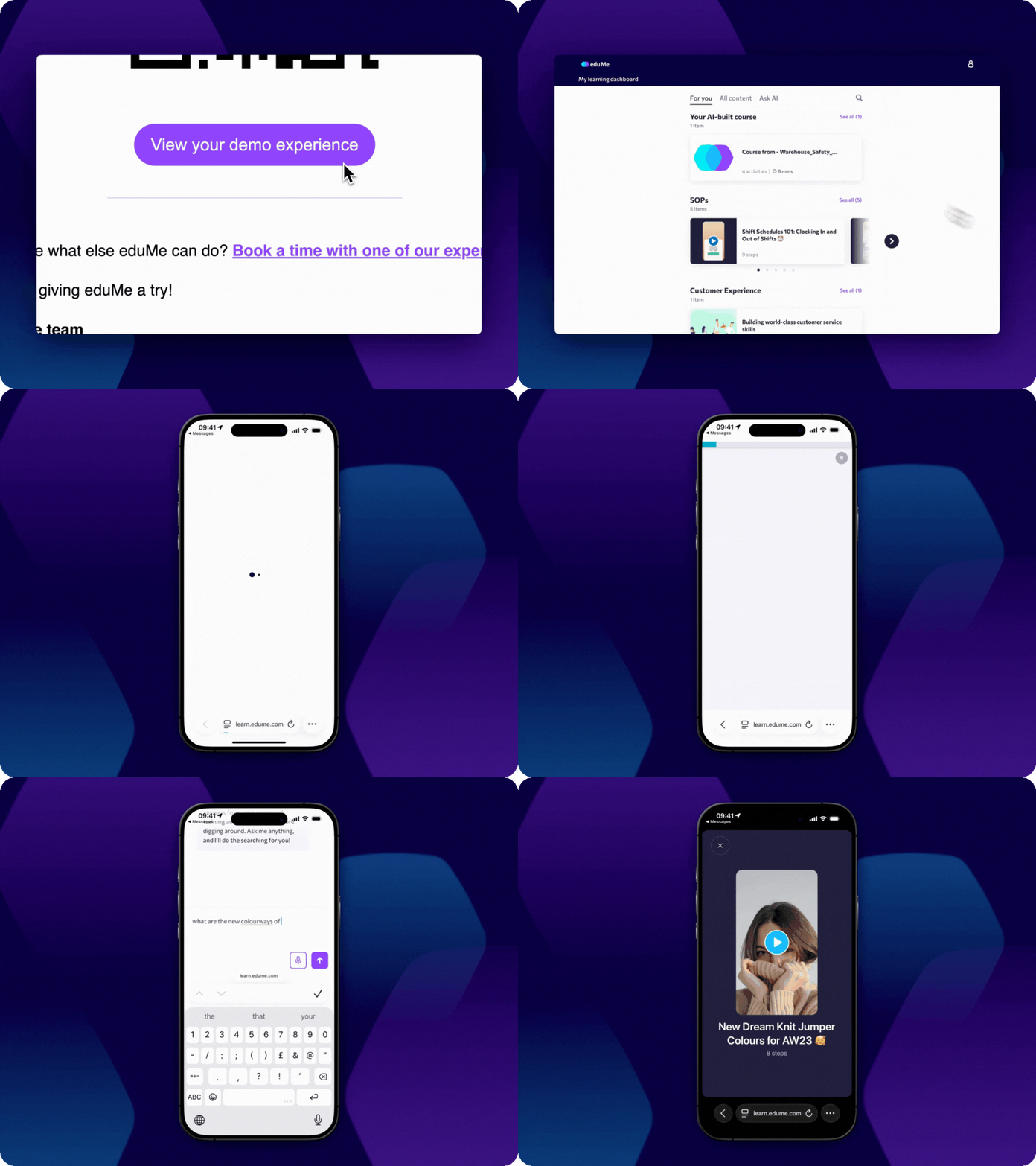
Experience eduMe in <60 seconds
No credit card required. No software to install. Just a hands-on preview of how frontline teams learn with eduMe.
Enjoyed this piece? There’s plenty more where that came from. We surveyed over 1,100 respondents to understand how AI is shaping frontline enablement in 2026. Download the full report here.
Join 10,000+ frontline leaders
Subscribe to ‘Training the Frontline’ and get weekly insights sent straight to your inbox.