TABLE OF CONTENTS

If you work in HR, L&D or frontline enablement, you probably have a lot -or at least a little - SCORM-based training sitting in your LMS or training tool of choice.
At the same time, your workforce has changed. Frontline employees in retail, hospitality, logistics or warehousing spend their days on shop floors, in vehicles or on site. They are part of the 80% of the global workforce that does not sit at a desk. Traditional elearning SCORM modules that live in a desktop LMS do not match their reality.
That leaves you in a difficult spot. You want mobile-first training that is short, relevant and available in the flow of work. You believe in frontline training that closes the gap between information, retention and action. You also know that rebuilding hundreds of SCORM modules from scratch is not realistic.
The question then becomes not whether SCORM should disappear, but how to move from SCORM to microlearning in a way that preserves value. Many modern organisations are now taking a hybrid approach - they keep the parts of their SCORM library that still serve them, and match it with purpose-built frontline training.
Why organizations feel stuck with SCORM
1. Sunk costs
Most L&D teams recall the effort that went into their SCORM based training. Internal courses were created with specialist authoring tools, often by external vendors or a small group of trained admins. Off the shelf content was purchased in multi year agreements. Regulatory teams still expect to see specific SCORM packages appear in reporting.
Replacing all of that feels impossible. Teams know they do not have the time or capacity to rebuild everything as microlearning. Many also worry about losing the audit history linked to existing SCORM modules. That is a rational concern, especially when compliance is involved.
At the same time, there is growing evidence that existing formats are underperforming. In eduMe’s State of Frontline Training, Tech and Trends report, half of frontline workers said they remembered their last training only somewhat or not well. This includes training that was technically completed, which suggests that format and delivery matter as much as content.
2. Platform lock-in
A second source of friction is platform lock in. Many organizations still rely on a single LMS that was originally bought to host elearning SCORM content. Over time that LMS becomes the system of record for courses, user progress and historical reports. Any thought of moving away from it raises a concern: what happens to all the SCORM files?
LMS centric workflows also assume workers can access a desktop or laptop. That might be true for headquarters roles, but it rarely holds for frontline teams. In a previous eduMe study, 83% percent of frontline workers reported being given desktop based training despite not having a desk. That misalignment contributes to low engagement, lower completion, and poor outcomes on the frontline.
3. Mismatch between work type and content offering
Modern frontline work is mobile. Staff use shared tablets, handheld devices or their own phones. They check shift schedules, communication tools and operational systems throughout the day. They do not log into complex portals for 10-20 minutes at a time unless required to - but doing so comes at a cost - time away from the floor translates to productivity lost.
In many organizations, someone eventually asks a fair question: can you make SCORM course compatible on mobile. The technical answer is that SCORM packages can often be launched on a phone, and some LMS vendors advertise mobile SCORM support. The practical answer is that this rarely produces a smooth frontline experience. Interfaces designed for large screens do not translate well to smaller ones. Long modules are difficult to navigate during a shift. Progress is easily interrupted.
The result is a sense that SCORM mobile learning is both necessary and hard, which is why many teams look for a different way forward.
The real role SCORM plays today: depth, compliance and third party content
SCORM still has a legitimate role in most learning ecosystems, but the value sits in a narrower band than it once did - much of that value relates to depth, audit requirements and externally supplied content.
Where SCORM still fits
Compliance programs often rely on SCORM because regulators expect to see completion data presented in specific ways. The structure of a SCORM package helps when assessments, content and tracking must sit together in a single unit.
Many organizations also receive training from software vendors, equipment manufacturers or industry partners as ready made SCORM files. These modules are maintained externally, so keeping them in their original format avoids unnecessary redevelopment.
Long-form conceptual topics can also benefit from SCORM. Some subjects require extended explanation or scenario-based assessment that does not translate well into short, mobile-first formats. In these cases, SCORM provides structure and continuity.
Where SCORM strains as a frontline tool
In frontline environments, the constraints are practical. Workers are mobile, often do not have corporate email and rely on shared tablets or personal phones.
The constraint is not that SCORM modules cannot be delivered on mobile devices and accessed by frontline teams when needed, but that the format was originally designed for longer, linear sessions on desktop environments.
Many frontline roles operate in short bursts of available time, move in and out of tasks quickly and need information that fits those rhythms. Long packages, even when mobile accessible, can still require more focus or time away from the floor than workers typically have.
The other limitation is update speed. Frontline procedures, product information and store level changes shift more quickly than many SCORM modules were designed to support.
Rebuilding and reuploading an entire package may not match the pace at which frontline teams need new guidance. The content still has value, but the lifecycle of SCORM can create friction when organizations are trying to communicate changes rapidly.
Workforce expectations reinforce this. In eduMe’s State of Frontline Training report, 63% of frontline workers said they want shorter training, and many said they prefer access within existing tools rather than separate destinations. SCORM provides important depth, but workers often need additional quick, contextual support in between full modules. This is where microlearning plays a complementary role.
2025 Report: The State of Frontline Training
Hear what 1,200+ leaders AND workers have to say about frontline training, tech and trends.
%20(1).png?width=2000&height=1500&name=WD%20Pocket%20Guide%20Mockup%201%20(transparent)%20(1).png)
Once SCORM is understood as a format for depth, compliance and vendor supplied content rather than everyday enablement, the path forward becomes clearer.
The challenge is not whether SCORM should be kept or discarded, but when to leverage it, and how to do so effectively within the unique context of frontline operation.
When this distinction is made, organizations can introduce mobile-first training for frontline contexts without discarding the work already invested in the SCORM-based.
Modernizing without starting over: the 'dual track' approach
A productive way forward is to adopt a dual track approach.
On the first track, organizations keep their existing SCORM based training where it genuinely adds value. Compliance modules, vendor content and deep conceptual courses stay as SCORM. They continue to be reported on, audited and used where necessary.
On the second track, organizations invest in microlearning that supports day-to-day behavior, readiness and various frontline training contexts and needs. These shorter modules do not replace every SCORM course. Instead they sit alongside SCORM and address what workers need in the flow of work.
In this model, SCORM provides depth and coverage. Microlearning brings context and frequency. SCORM allows teams to meet certain obligations. Microlearning helps workers apply what they have learned.
This dual track approach helps teams move from a world dominated by elearning SCORM toward one where frontline enablement is the focus. It also avoids the all or nothing choice that stops many projects before they start. You do not have to move from SCORM to microlearning in one leap. You can run both, with a clear understanding of what each is for.
Many of the companies we speak to have adopted this hybrid model. For them, the question is no longer whether SCORM should exist. The more important question is how to bring SCORM into a broader frontline enablement strategy.
What about SCORM converters?
Those seeking 'SCORM converters' often come from teams who assume that conversion is the only way to modernize and move forward. In practice, conversion alone does not address the real problem. The challenge is not the wrapper - it's the workers ability to reach the right material and the right moment.
If a long module becomes a different type of package, but still sits behind multiple clicks on a desktop, frontline workers still cannot reach it when they need it.
The re-frame should be around identifying what workers actually need from each piece of content. In many cases, they need a clear explanation of a process, a short reminder before a shift or a quick way to step-check while serving a customer.
Modern ways of serving these needs include embedding contextual QR codes around the workplace, that support one click access to relevant associate information (for example: 'Returns on the POS system'). AI is also innovating here - allowing workers to circumvent lesson access/completion altogether in favor of simply asking a company-educated, expert AI bot that can return the specific nugget they want in a simple sentence, in seconds.
Those jobs can be supported by building microlearning around existing SCORM modules rather than converting the modules themselves.
Conversion tools have their place, especially when moving between legacy systems - it's often not a clean cut 'upcycle' or 'kill' when it comes to pre-existing content. But when reimagining training for the frontline, context-based relevance and seamless delivery trumps forcing something into a structure in which it inherently does not fit.
How organizations are executing SCORM-microlearning hybrid strategies
The organizations that are making progress in this area have a few patterns in common.
Many start by importing third party SCORM training into a platform that supports both SCORM and mobile friendly lessons. This removes the need to manage two separate systems. SCORM LMS upload becomes one workflow among others, rather than the only way content enters the environment.
From there, teams build microlearning around their most important SCORM modules. They take the steps that matter most in daily work and turn them into short, tappable lessons that can be opened on a phone or tablet. These might cover a new promotion, a critical safety procedure or a common systems task.
Several teams include links in tools frontline workers already use, such as workforce apps or communication platforms, like Workday Learning or Microsoft Teams.
Some organizations choose to segment access carefully. Rather than send every new lesson to everyone, they use role, location, seniority, or information around previous lesson completions or scores to target content. This avoids blanket sends that irritate workers and create an association between training and irrelevance.
Many also take advantage of AI to reduce manual work. In eduMe, document import and AI assisted creation allow teams to upload existing material and receive a mobile first draft in minutes. This approach has seen training creation time cut by 70% for some customers.
Several companies invite frontline workers to contribute content in a social, bottom-up, crowdsourcing strategy. Governance is retained at the top level, but employees are allowed to contribute with short videos on-the-ground, reducing admin burden and increasing content relatability. When they see familiar contexts and colleagues, training feels more relevant and easier to trust.
➜ Learn how Temco saved 600k with their frontline training strategy
All of this is possible without adding new headcount. The work lies in choosing where microlearning will have the most impact, and using existing tools in smarter ways.
What this unlocks for L&D and Operations
A hybrid approach gives both L&D and Operations a more flexible, responsive way to support frontline teams. When SCORM and microlearning work together, each format contributes to a different part of the training and enablement journey.
1. Faster change adoption
Frontline teams work in environments where processes shift quickly. New products, promotions or procedures need to be understood in a short timeframe. Microlearning supports this by giving workers brief, accessible updates that fit around their shifts.
Because lessons open within familiar channels such as workforce apps, shared devices or communication tools, engagement is higher. This reduces the gap between decision and execution and helps managers introduce changes with fewer delays.
2. Stronger reinforcement loops
Reinforcement is often where traditional SCORM-based training loses momentum. Long modules are rarely revisited, even when the content is important.
Short reminders, single topic guides and quick reference material make reinforcement easier. This supports findings from our State of Frontline Training Report, which found that 50 percent of frontline workers struggled to recall information from their most recent training session.
Providing smaller follow up lessons or check steps keeps information active and helps prevent knowledge decay.
3. Better visibility and a clearer picture of readiness
When SCORM and microlearning run through the same platform, reporting becomes more connected.
Teams can see progress inside long form SCORM modules alongside engagement with shorter lessons.
This reduces reliance on completion rates as the primary measure of success and gives a more rounded view of actual readiness. It also means L&D and Operations can look at behavior, not just activity.
How to begin a SCORM to microlearning transition
Moving from a SCORM only model to a dual track approach does not need to be complicated.
1. Audit your SCORM library
Start by reviewing existing SCORM modules and placing them into three groups: compliance and regulatory, vendor supplied and internal skill or behavior based content.
This clarifies where SCORM is genuinely required and where alternative formats can play a role. It also helps teams see how much of their current library is tied to external obligations versus internal preferences.
2. Identify high frequency, high impact actions
Within internal modules, look for tasks that frontline teams perform repeatedly. These are often process steps, customer facing actions or operational checks. Extracting these into short lessons supports scorm to microlearning in a practical way. It also gives workers access to information they need in moments rather than in long sessions.
3. Move SCORM into a platform that supports mobile access
Select a platform that can host SCORM and deliver microlearning in parallel. This keeps everything in one place and reduces friction for workers. It also answers common questions about what platform supports SCORM for mobile without requiring teams to maintain separate systems for different formats.
How organizations use eduMe as the bridge
1. Segmentation, targeting and role-based pathways
Teams move from blanket distribution to selective delivery. SCORM modules stay available, but targeting can be set up based on role, location, seniority, tenure, or previously completed content.
This reduces noise and avoids the common pattern where frontline staff associate “training” with irrelevant tasks. Relevance increases, perception improves and workers spend time on material that actually matters to their day.
2. Delivering training through everyday touchpoints
Training becomes easier to access when it appears in the places workers already check. Some organizations - like Uber - choose to surface eduMe inside their own apps. Others use their communication or HR systems, such as workplace communications tools like Microsoft Teams, or HRIS/HRM systems like Workday or ADP.
Several teams also introduce external access points. Common options include WhatsApp links, SMS, email and QR codes placed near workstations. Each route gives workers a familiar, low effort way into training.
Most organizations pair more than one of these entry points. When training is woven into multiple touchpoints, workers encounter it in the natural flow of their day, which increases adoption across different devices, shifts and environments.
3. Meeting frontline teams on the devices they already use
Frontline roles rely on personal phones, shared tablets and handheld devices. eduMe supports cross-device access without requiring new hardware or parallel platforms.
This brings SCORM and microlearning into the same mobile-friendly ecosystem, reducing the friction that often limits engagement.
4. Complementing SCORM with frontline-fit formats
Alongside existing SCORM modules, organizations introduce short lessons built through AI-assisted authoring, imported documents or contributions from frontline teams.
Photos and videos captured in real environments make training feel specific to the work context. The social-style, tappable format matches how people already consume information, which helps fill the gaps between longer SCORM modules.
5. Shifting from completion to readiness
When SCORM and microlearning sit together, both contribute to a single view of performance. Teams can distinguish between completion and capability.
eduMe’s skills validation features via in-person assessments help managers or external/in-house assessors confirm whether workers can actually perform key tasks, not just whether they reached the end of a module. This re-shifts the focus to assessing readiness rather than monitoring completion - a passive indicator of competence.
Closing thoughts
SCORM has been part of corporate learning for more than two decades. It will not disappear overnight, and in several areas it still serves a purpose.
At the same time, frontline teams need something different. They need training that fits into their day, works on the devices they have and helps them act with confidence.
Fortunately, you do not need to choose between keeping SCORM and modernizing - a thoughtful approach ets you preserve what you have, while building a frontline enablement layer that reflects how work actually happens.
If you would like to see how this can work in practice, you can try eduMe for free and explore how SCORM and microlearning can live together in a single, frontline-fit, mobile-first environment.
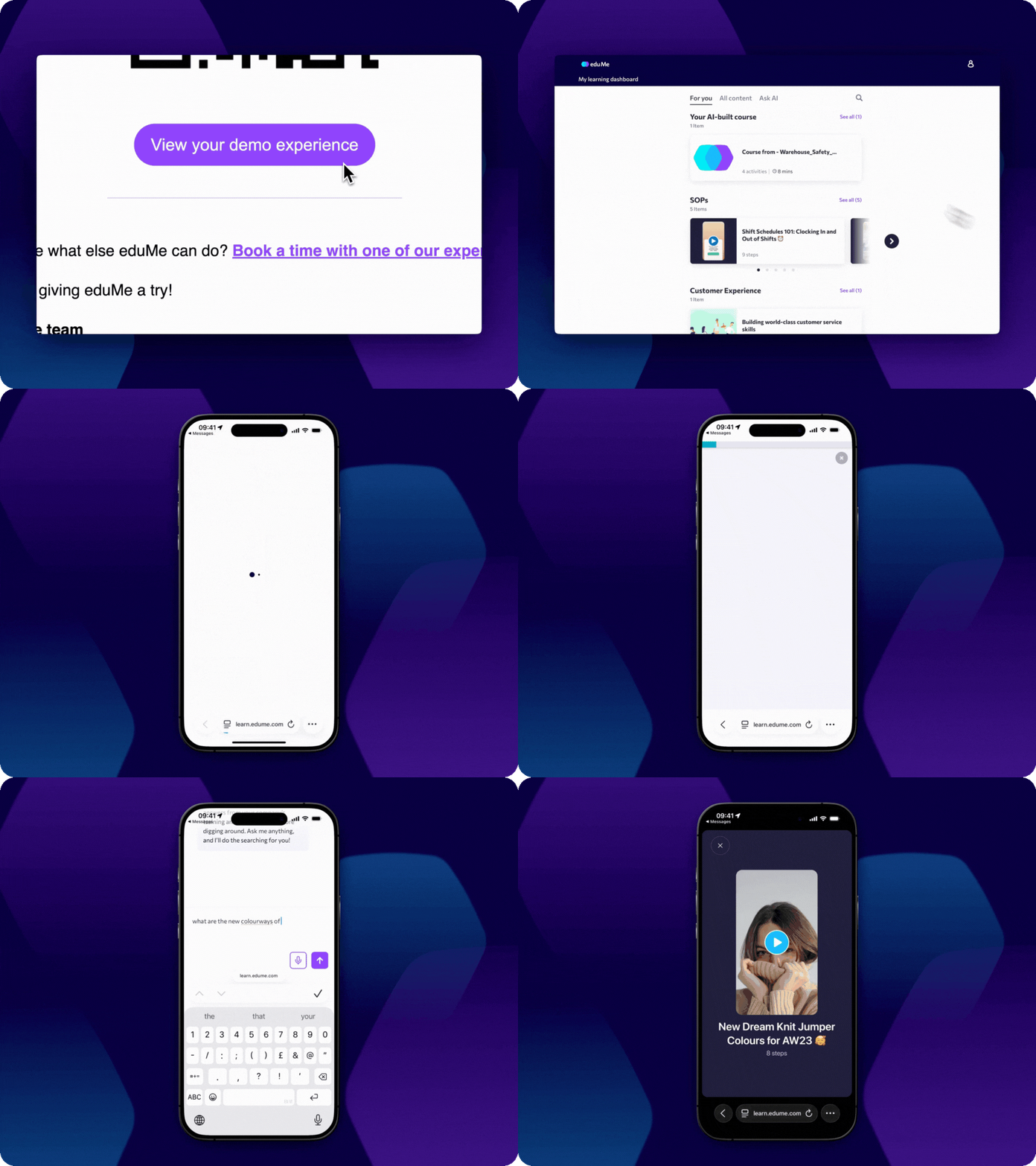
Experience eduMe in <60 seconds
No credit card required. No software to install. Just a hands-on preview of how frontline teams learn with eduMe.
Join 10,000+ frontline leaders
Subscribe to ‘Training the Frontline’ and get weekly insights sent straight to your inbox.