TABLE OF CONTENTS

Every hiring funnel leaks somewhere, whether that's a candidate who views the listing and never applies, one who applies and never books an interview, or one who accepts an offer and never turns up on day one. Each of those moments has a name and a cause, and usually a fix that costs a lot less than replacing the hire you're trying to make.
It shows up in every industry, but it's sharpest wherever hiring happens at volume, hourly, seasonal, and frontline roles, where a single leaky stage can mean dozens of open shifts.
That's what our Customer Success Lead, Aiive Biermans, walked through in a recent session with Workday Recruiting on cutting candidate drop-off across the funnel. Watch the full playback here for the live version, including audience Q&A.
Why candidates are dropping out of your funnel
Three things drive most of the drop-off, and most of it happens earlier than people expect, right at the application, before a candidate ever reaches an interview. Here's the order it tends to show up in.
1. Friction
The application process itself is often the first thing to go wrong. 92% of people who start an online job application never finish it, and the average Fortune 500 application runs to 51 clicks and takes close to 5 minutes, data originally reported by Appcast and InFlight, via SHRM.
The length of the form matters too: applications under 5 minutes convert 245% higher than ones over 15 minutes. Every extra document upload, every pre-screener question, every field that asks for information already sitting in an uploaded resume, is a chance for someone to close the tab.
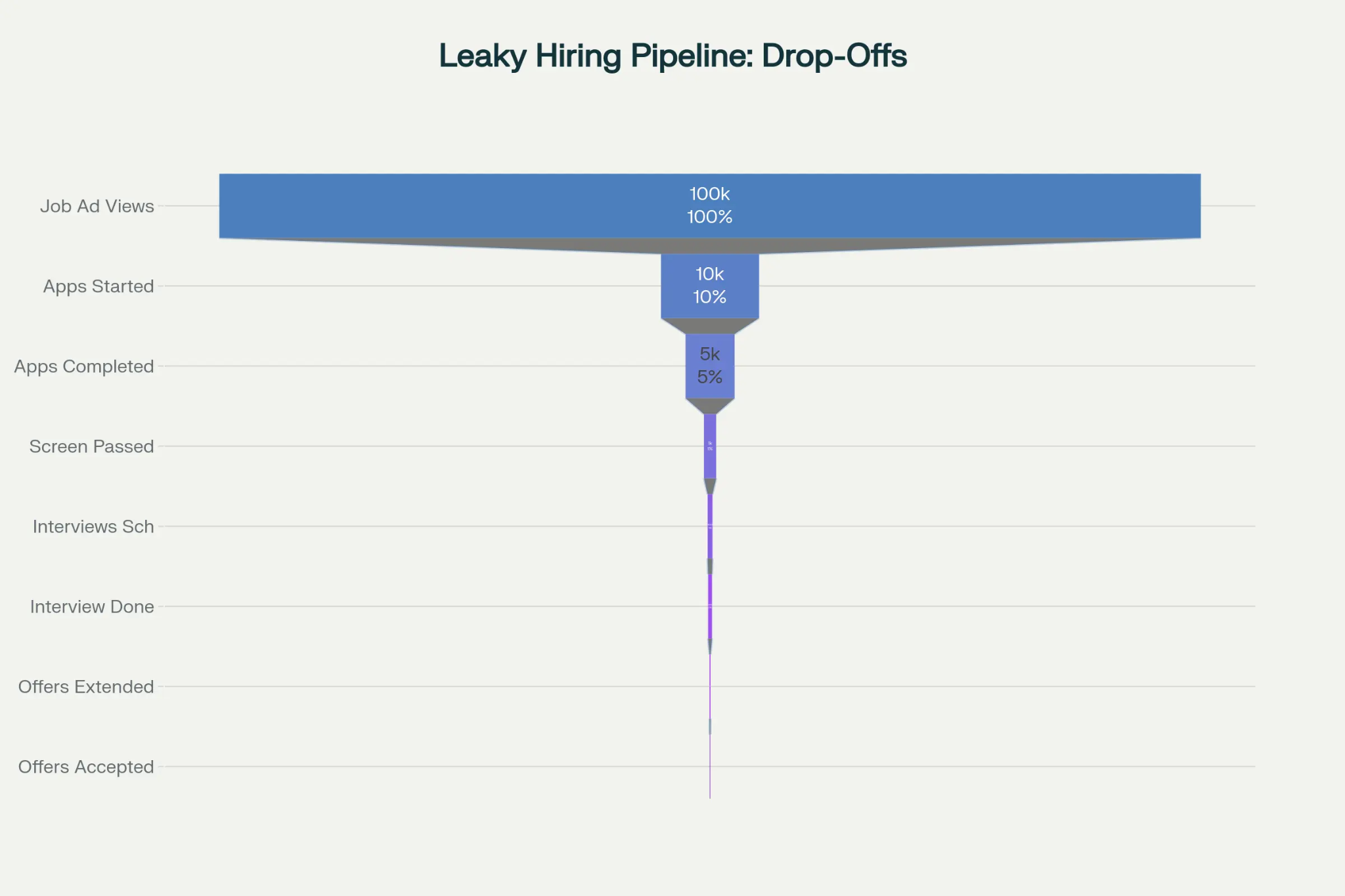
Hiring funnel drop off, by stage. Source: SkillSauce
2. Generic communication
A clunky form is only half the problem. If the job spec reads like every other job spec, it does nothing to offset the effort of applying. 71% of candidates say they're discouraged from applying by jargon in job ads.
A conversational (and true-to-your-company tone) will make all the difference - think of your job spec as a piece of marketing collateral: copywriting is king.
A useful test: could you delete your company's name from the posting and have nobody notice? If yes, the spec isn't doing its job.
Slow or unclear communication
The final driver shows up after someone has already applied. 42% of candidates have abandoned a process because interview scheduling took too long, and the same candidates are 48% less likely to recommend that employer afterward.
Silence reads as rejection fast: 34% of candidates assume they've been ghosted after just a week without word, and SHRM's own research found 78% of applicants never hear back from an employer at all.
Delays happen for legitimate reasons, a hiring manager on vacation, two strong candidates to weigh, a re-think on interview order, but the candidate never sees any of that. They just see silence, and they act on it.
Fixing the funnel, stage by stage
None of this means starting from scratch. Think of it as a hiring funnel audit you can run yourself: be deliberate at each point a candidate can drop, and the fixes get more specific the further down the funnel you go. Whether you're filling ten warehouse shifts a week or running a corporate graduate scheme, the same audit applies.
1. Turn your application into something candidates actually finish
The first fix is the most mechanical: cut friction wherever it isn't earning its keep. That means one identity verification flow, not two, autofilling anything already captured in a resume upload, and holding the line at one pre-screener question rather than three.
Keep the form itself under 5 minutes where the role allows it, and test it on a phone screen before it goes live, since most applicants are applying from one. Every minute shaved off shows up directly in your candidate conversion rate.
The second fix is about what the listing communicates, not just how long it is. Most candidates skim straight to the experience section, so the listing itself should be edited for that reality: shorter, plainer, and specific to the actual role rather than a template.
Beyond the copy, the single highest-impact addition tends to be a short employee-generated video, someone actually in the role, filmed on a phone, walking through a typical day. It doesn't need a production budget, just enough reality that a candidate can picture themselves in it.
2. Keep candidates moving after they hit apply
Once someone applies, the risk shifts from the form to the silence. The baseline fix is making sure every automated touchpoint actually works, the post-application acknowledgment email lands somewhere other than spam, since after a week of nothing, 34% of candidates assume they've been ghosted.
Past that baseline, the highest-leverage additions are small pieces of content that do double duty: they inform, and they leave an impression.
If candidates are opening a scheduling email and not booking, a short screen-recording that walks through exactly how to do it removes the ambiguity in one shot. Delivery platform Grubhub saw a 15% uplift in start rate, the share of new hires who go on to actually complete a first shift, after simplifying exactly this kind of instructional content.
An acknowledgment email with actual character, rather than a templated auto-reply, does the same work the job spec is supposed to do.
A short video covering what to expect at the interview, e.g. (if in-person) - where to park, where to check in, who they'll meet, serves the same purpose and can be filmed once - even better if by the actual person who runs the interview - and sent on repeat, each time.
3. Close the gap between offer and day one, fast
The offer stage isn't really about persuasion anymore. Retention tends to be highest by this point in the funnel, so the job is logistics, not convincing.
The risk here is delay, and delay is almost always caused by the same handful of repeat questions or missing pieces of information. The fix is to reverse-engineer whatever your team already answers on repeat.
If new hires keep showing up on day one missing a required piece of identification and it's pushing their start date, a short, mostly visual piece of content showing exactly what to bring and what to leave behind solves it before it happens, rather than after.
4. Make day one feel like the job they signed up for
The final stage covers everything from an accepted offer to a productive first month, and the clearest failure mode is a no call, no show on day one, alongside slower ramp-up and early turnover, all more common in seasonal, gig, and frontline roles than in salaried corporate ones.
Two things work in combination. The first is building a sense of belonging before someone ever sets foot on site, a welcome message from leadership does a disproportionate amount of work here.
The second is preparing people practically: dress code, arrival time, a simple site map, so day one doesn't start with avoidable confusion.
Ride-hailing company Alto replaced a full day of in-person orientation with exactly this kind of bite-sized, self-paced content, and cut time to productivity by 70%, taking new drivers from up to 14 days before their first ride down to an average of 16 hours.
Internally, eduMe's own data across on-demand and gig customers also shows first-shift no-show rates falling by as much as 5.7% once this kind of preboarding content is in place.
There's a balance to strike on how much to share and when. A piece of equipment that requires physical, hands-on skill (like operating a point-of-sale system) is still best taught by a manager or peer in person, not via a video ahead of time.
What a video ahead of time should cover is the logistics around that task, arrival time, the day's agenda, and where that hands-on training will happen.
Whatever the role, tailoring content to what actually motivates a new hire in it matters more than generic onboarding content ever will. For example: speed of earning in gig roles, or clarity of progression in a corporate one.
How Southeastern Freight Lines built belonging before day one
Southeastern Freight Lines is a family-owned trucking company built around next-day delivery, with a frontline-heavy workforce of drivers, dock workers, and fleet technicians.
Getting new hires productive quickly, safely, and without early drop-off matters more here than in most office environments.
Their use case sits right at the point this piece keeps returning to: post-offer, pre-day-one. The company describes its workforce as the backbone of the business, and wanted new hires to feel that from the very start, not after weeks on the job.

An example of the employee-centred, preparatory first-day content that can be embedded post 'Offer' stage, that helps reduce candidate funnel drop off.
To do that, they're recording a direct message from the CEO speaking to the company's values, sent out before a new hire's first day even begins. Every new hire gets the same message, at the same point, rather than a version that depends on which manager happens to deliver it.
Alongside that, first-day logistics content, what to wear, where to check in, what the day looks like, means new hires walk in with the basic uncertainty already resolved, and managers aren't left fielding the same questions individually on an already busy first day.
How eduMe's Workday Recruiting integration makes this practical
Everything above, the day-in-the-life video, the interview scheduling screen recording, the welcome message from leadership, the first-day site map, is the kind of content eduMe is built to create and deliver, as a frontline enablement platform. Our integration with Workday Recruiting is what gets that content to the right candidate at the right funnel stage, running alongside whatever Workday Recruiting itself is already sending, not replacing it.
Once a one-time sync is set up, candidate data flows into eduMe automatically, no manual list building. Because candidates aren't yet inside Workday itself, content reaches them by SMS or email, and clicking through takes them straight to the content, no login, no app download, no password to set.
Because it's all tracked by stage, role, and location, it maps straight onto the hiring KPIs a talent acquisition team already reports on, one more lever for improving your hiring funnel without adding headcount.
For the mechanics of Workday Recruiting itself, check out our Ultimate Guide to Workday Recruiting.
The fastest way to see whether this fits your own hiring funnel is to watch a short, 2 minute demo of how eduMe integrates into Workday Recruiting to improve TA outcomes - from improving funnel conversion rates to reducing average time to hire.
Embed enablement into the flow of your hiring funnel
See how eduMe integrates with Workday Recruiting to reduce candidate drop off, improving hiring funnel retention and first-day readiness.
.gif?width=1400&height=1100&name=WD%20Recruiting%20-%20SMS%20(gradient%20background).gif)
Join 10,000+ frontline leaders
Subscribe to ‘Training the Frontline’ and get weekly insights sent straight to your inbox.