TABLE OF CONTENTS

LinkedIn Learning is one of the most widely adopted learning platforms in the world. Its professionally produced courses, broad topic coverage, and strong reputation make it a default choice for many organizations investing in employee development.
Yet when LinkedIn Learning is rolled out to frontline teams, adoption and impact often look very different. Courses go underused, relevance feels limited, and training struggles to translate into consistent execution on the job.
This is not because LinkedIn Learning is ineffective. It is because frontline teams operate under different conditions. Time is fragmented. Devices are shared. Work happens inside operational systems. Training needs to reflect specific processes, products, and locations.
As a result, many organizations do not replace LinkedIn Learning outright. Instead, they start to evaluate LinkedIn Learning alternatives and complementary tools to build a training stack that actually reaches the frontline.
Follow along or click a link to the left to jump to your section of interest.
LinkedIn Learning alternatives at a glance
| Platform | Primary role | Best suited for | Where it fits for frontline teams | Key trade-offs |
|---|---|---|---|---|
| LinkedIn Learning | Curated content library | Career development and general skills | Useful for standardized topics and soft skills | Generic content, limited process specificity |
| OpenSesame | Aggregated course marketplace | Broad coverage and compliance content | Works well for identikit training | Publisher-led, limited contextualization |
| Workday Learning | System of record for learning | Governance, reporting, aggregation | Foundational for HR-led training | Not embedded in day-to-day frontline workflows |
| eduMe | Frontline enablement layer | Execution, guidance, consistency | Purpose-built for frontline delivery | Not a generic content library |
Why LinkedIn Learning?
LinkedIn Learning is built around a curated catalog of professionally authored courses covering business, technology, and creative skills. Content is produced through a structured authoring process and reviewed to ensure quality and consistency, which has helped establish the platform as a trusted source for professional development.
Professionally authored, general-purpose learning content
Courses on LinkedIn Learning are designed to be broadly applicable across industries and roles. Topics such as leadership fundamentals, communication skills, software training, and personal productivity form the backbone of the catalog.
This makes LinkedIn Learning particularly effective for knowledge workers and office-based teams, where training is often exploratory, self-directed, and focused on long-term skill development rather than immediate task execution.
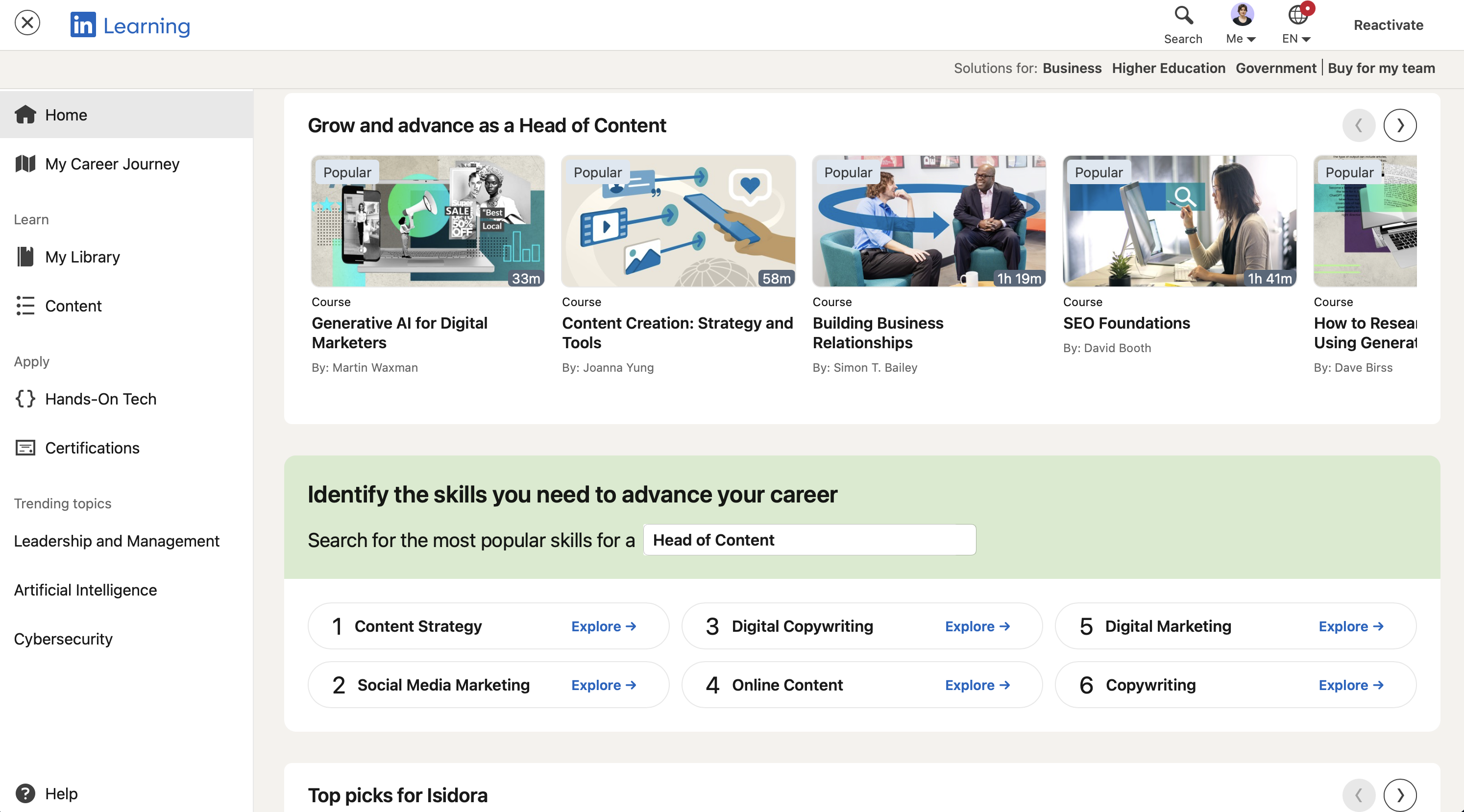
LinkedIn Learning home: the platform curates professionally authored courses based on a user’s profile, role, and interests, emphasizing general-purpose skills designed to support long-term career development.
Where LinkedIn Learning fits in frontline organizations
For frontline teams, LinkedIn Learning tends to be most useful for standardized training that does not vary by site or role. Examples include compliance awareness, general safety principles, or soft skills training that applies uniformly across the organization.
Where it becomes less effective is in areas that require company-specific detail. Frontline teams often need training tied to internal processes, local operating procedures, and specific products or SKUs. That level of specificity is outside the scope of a global content library, regardless of its quality.
Why OpenSesame?
OpenSesame approaches the problem from a different angle. Rather than curating content internally, it operates as a marketplace that aggregates courses from a wide range of publishers.
Aggregated course marketplace model
The strength of OpenSesame lies in breadth. Organizations can source thousands of courses across compliance, safety, IT, leadership, and industry-specific topics through a single procurement channel.
This model is attractive for teams that need coverage across many subjects or operate in regulated environments where standardized training content is required.
When OpenSesame makes sense for frontline teams
For frontline organizations, OpenSesame is often used to support compliance training and mandatory certifications that are largely identical across locations. In these cases, publisher-produced content reduces the burden on internal teams to create and maintain material.
As with LinkedIn Learning, the limitation is not quality but relevance. Marketplace content is not designed to reflect a company’s unique workflows, systems, or product mix, which means it rarely supports day-to-day execution on its own.
Why Workday Learning?
Workday Learning plays a different role in the training stack. It is not primarily a content provider, but a system for managing, distributing, and tracking learning across the organization.
Workday Learning as the system of record
For many enterprises, Workday Learning serves as the central place where learning activity is governed and reported. It supports assignment rules, completion tracking, and compliance reporting, and is typically owned by HR or L&D teams.
This makes Workday Learning foundational rather than optional, particularly in organizations already running Workday as their core HCM.
Aggregating LinkedIn Learning and OpenSesame
Workday Learning commonly acts as an aggregation layer, distributing content from platforms such as LinkedIn Learning and OpenSesame through a single interface. This allows organizations to centralize reporting and provide learners with access to multiple libraries without managing them separately.
In practice, many organizations rely on this setup to meet compliance and development requirements across large workforces.
Where Workday Learning stops short for the frontline
Despite its importance, Workday Learning is not designed to be where frontline work happens. Access is typically separate from operational tools, and learning is consumed as a discrete activity rather than part of the workflow.
For frontline teams working on shared devices or under time pressure, this separation can limit adoption. Training may be available, but not accessible at the moment it is needed.
This is the point at which many organizations introduce an additional layer.
Where content libraries reach their limits on the frontline
Content libraries and LMS platforms solve an important class of problems. They provide coverage, consistency, and governance for training that needs to be standardized.
Frontline execution introduces a different set of requirements.
- Training often needs to reflect internal processes rather than general best practice
- Product knowledge must match current SKUs and local assortments
- Information needs to surface inside the systems workers already use
- Learning moments are short and unpredictable
These conditions do not negate the value of content libraries. They highlight a gap between learning content and execution support.
How eduMe complements content libraries and aggregator platforms
eduMe is designed to fill that gap. Rather than replacing content libraries or Workday Learning, it sits alongside them as a frontline enablement layer.
Authoring frontline-specific training
eduMe allows teams to create training and guidance that reflects how work is actually done. Content is built around internal processes, products, and SOPs, and can be updated quickly as operations change.
This makes it suitable for training that cannot be outsourced to generic libraries.
Embedded delivery alongside Workday Learning
eduMe is designed to integrate with systems already in use, including Workday. Training and guidance can be surfaced through shared devices, embedded links, or directly within existing applications.
In organizations using Workday Learning, eduMe is typically added rather than substituted. Workday Learning remains the system of record, while eduMe handles frontline delivery and execution support.
From content to execution
By connecting training, knowledge, and guidance, eduMe helps standardize execution across locations and roles. The focus is not on browsing courses, but on ensuring workers have the right information at the right moment.
This shift from content consumption to execution support is what differentiates frontline enablement from traditional learning platforms.
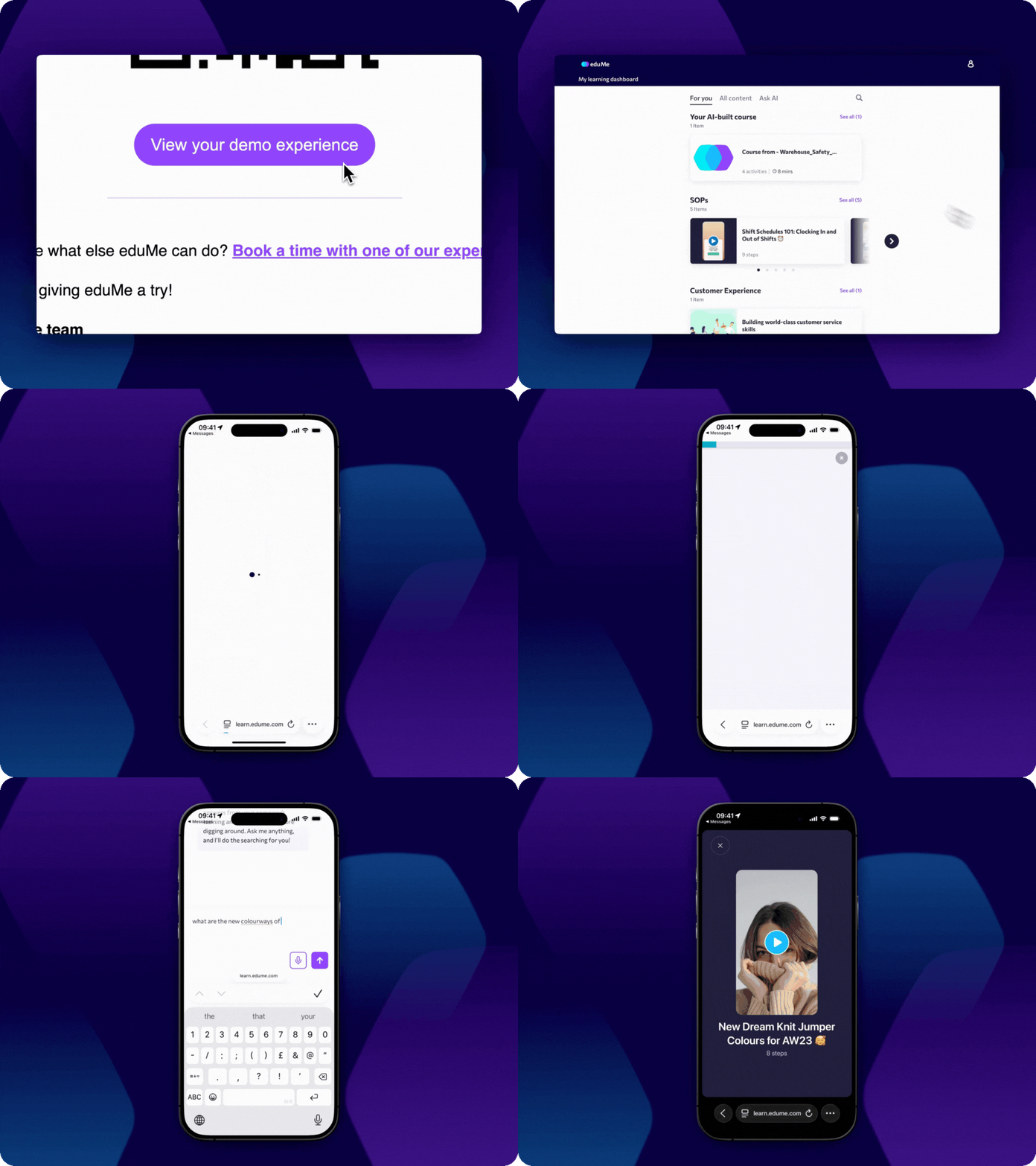
Experience eduMe in <60 seconds
No credit card required. No software to install. Just a hands-on preview of how frontline teams learn with eduMe.
Final verdict: building the right frontline training stack
LinkedIn Learning and OpenSesame remain valuable tools for delivering standardized content and supporting broad skill development. Workday Learning continues to play a critical role as the system of record for learning governance and reporting.
For frontline teams, these platforms are often necessary but not sufficient. When training needs to be specific, contextual, and embedded into daily work, organizations add a frontline enablement layer rather than replacing their existing stack.
That is where eduMe fits. It complements content libraries and Workday Learning by supporting execution where generic training stops.
In conclusion, most organizations do not choose between these platforms in isolation. They combine them based on the role each plays in their training stack.
-
Use LinkedIn Learning when you need broad, professionally authored content for knowledge workers and standardized topics.
-
Use OpenSesame when breadth and third-party compliance content are the priority.
-
Use Workday Learning as the system of record that governs, aggregates, and reports on learning activity.
-
Add eduMe when training needs to reach the frontline intuitively, reflect internal processes and products, and support execution inside daily workflows.
If you want to understand how this works in practice, we offer a free, guided eduMe trial that shows how frontline training and guidance can be delivered directly in the flow of work.
Join 10,000+ frontline leaders
Subscribe to ‘Training the Frontline’ and get weekly insights sent straight to your inbox.